Episode Transcript
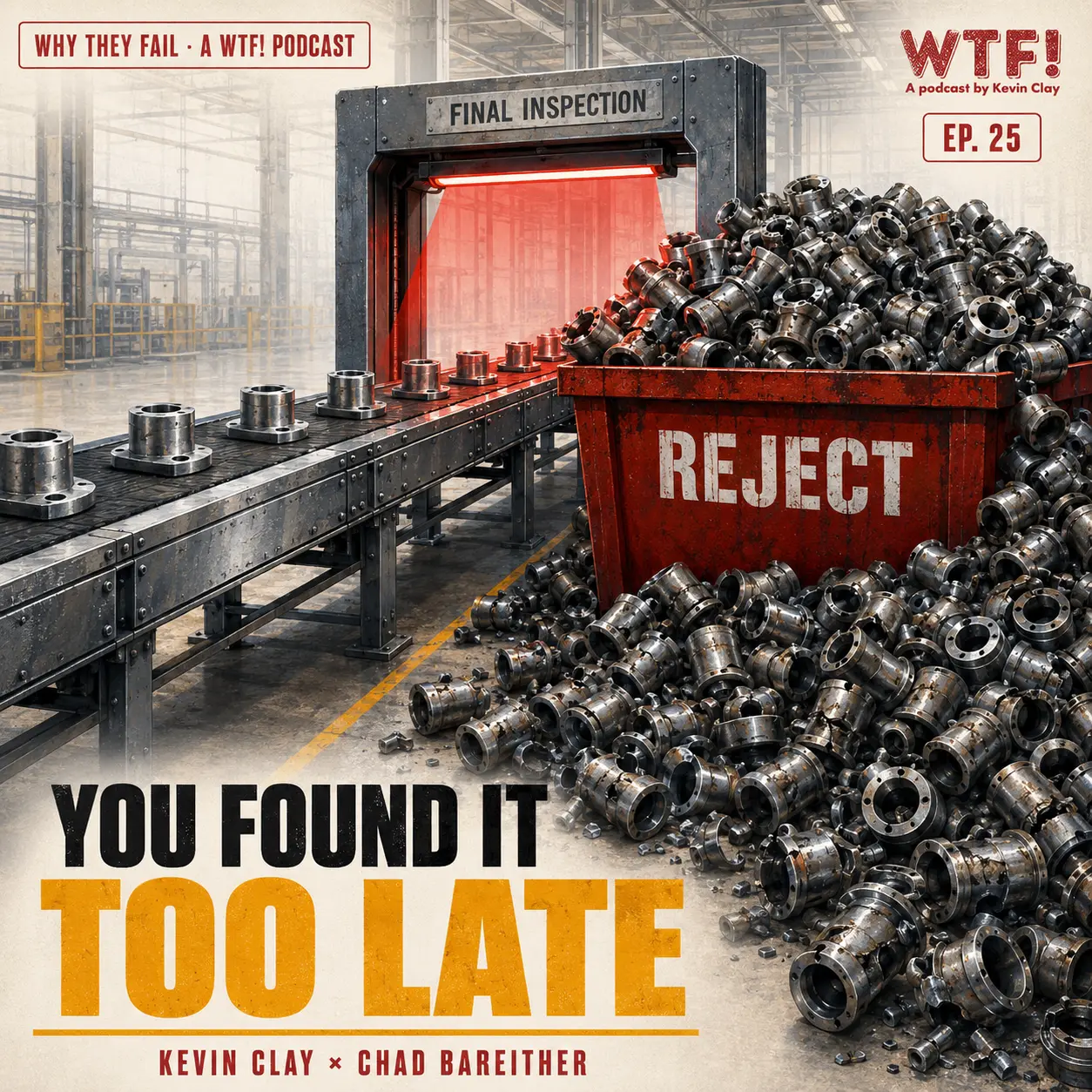
[00:00:00] Speaker A: When you are beholden to end of line measurement, the quality control function quickly becomes the police and almost the adversary of operations. I think end of line inspection and this we'll see legacy approach to inspecting in quality also creates a little bit of organizational friction of you know, quality's job should be working with production to ensure quality at the source, not inspected in at the end. And when we do, we're left in these situations of organizational failure welcome to why they Fail, the podcast that pulls back the curtain on why continuous improvement efforts fail. Buckle up because we're not here for motivational fluff. We're dissecting the short sighted decisions and leadership agendas that sabotage CI success.
But don't worry, we'll clue you in to the few simple keys to success to avoid these pitfalls. If you're ready for the truth, let's do this.
[00:01:09] Speaker B: Welcome back to why they Fail the podcast where we dive deep into the real reasons continuous improvement initiatives crash and burn and how top operational leaders build systems that actually last.
I am your host Kevin Clay, Master Black Belt and President of Six Sigma Development Solutions. In today's episode we are tackling a massive systemic issue that plagues far too many organizations, relying on end of line inspection instead of controlling your processes from the ground up. Joining me today is Chad Bereither, a seasoned continuous improvement leader and author with over 20 years of hands on operational excellence experience.
Chad began his career as a quality and industrial Engineer with the U.S. army Armament Research, Development and Engineering center and Caterpillar and managing product life cycles, weapons stockpiles and heavy equipment production before launching his consulting practice over seven years ago to help mid sized organizations focus, align and scale. You can connect directly with Chad and learn more about his work by checking out the link to his LinkedIn profile in the show notes below.
He is also the author of the powerful book Improve Less which teaches leaders how to strip away administrative noise and focus on the few vital strategic objectives that truly move the bottom line.
In this episode, Chad and I dissect why waiting until the end of a process to catch defects is a costly organizational failure, how inspect in quality destroys company culture and how to align leadership around actionable process metrics that drive real financial performance.
Let's get right into the conversation.
[00:03:04] Speaker C: Chad, what was your catalyst that got you into continuous improvement? What led you to the point which you are now and writing your book?
[00:03:13] Speaker A: My first professional job was at the US Army Arctic Armament Research Development Engineering center and we managed life cycle of different products that were fielded to our war fighters and There is a document that we use for quality control. It's Military Standard 1916. If you wanted to look that up line, It'd be like mil dash std dash 1916. And within that document it's referred to the Department of Defense preferred methods for acceptance of product. I was a quality engineer. This was our bible, if you will, about so how do we manage product quality so when it gets to our servicemen and women that it's effective and reliable. And the first half of that document is all about process control, mistake proofing, monitoring of KPIs and statistics, statistical process control. And then the back half basically says it has a pivot and says if you can't do that then at least do end of line sampling. And so I looked at the contracts that we had and 90% of the contracts were all on sampling inspection. And I scratched my head and I said, well almost like has no one read the first half of this document? And so I was, I'm sure a brash, overconfident 20 something and just started asking those questions. And on future contracts we tried to move suppliers that I was working with from sampling inspection to more process control. I end up making some really good progress, building some good inroads and relationships with teams. And just by happenstance, we are also piloting a new program for continuous improvement within the army called Lean Six Sigma. About the time I have this run in and this epiphany with Military Standard 1916, I'm trained and certified as a green belt. So now not only do I have these preferred methods that I also studied in university, but now in the workplace and then amplified my tools into a DMAIC framework for solving problems. I just felt the whole thing is like there was, you know, clouds parted, maybe it's a little cheesy but like clouds parted, I was like this makes so much sense. And I knew I that was my niche, what I want to do for the career and went on for that into two or three other corporate positions and then eventually leveraged out of that 15 years of experience to start consulting for mid sized organizations. And that's already seven years ago history
[00:05:31] Speaker C: with the arming coming in, using that, the mil standards. I think you said 1916.
[00:05:38] Speaker A: Yes.
[00:05:39] Speaker C: Seeing that inspection was kind of done at the end of the process rather than building quality into the process. What was the defining catalyst that really caused you to walk away from a standard mechanical engineering desk to chase production system puzzles on the factory floor?
[00:05:56] Speaker A: Yeah, that's an interesting question. I think it even preempts that I Had this clarity, I'd say, on continuous improvement at that point, when I was already with the US army working in acquisition workforce. My decision to move away from mechanical engineering actually happened when I was working for Caterpillar several years, maybe five years before that, working at Caterpillar in a internship as a design engineer and making modifications to this torsion box lift arm that they were doing, which lots of math, lots of fun I was having playing in CAD and finite element analysis. But the best part of my day would be going down to the production floor to talk with the manufacturing engineers about changes I was considering and what the impacts on production would be. And I just remember, like, I almost couldn't hear what there's. I'm like looking around on the floor, I'm like, it's way more fun down here. Like, this is like actually taking the design and making it happen. Because I had a professor at Michigan Tech, his name was Craig Frederickson, and he taught a Design for Manufacturability class that I took. And I still remember this quote. He said, it's like, the best design in the world isn't worth anything if you haven't thought about how you're going to produce it. And so then it's like, should have had a V8 moment. I'm just thinking about how I'm going to produce the design. The actual industrial engineering, which I didn't even know was a thing up until then. So the manufacturing of the industrial engineering became more of like, no, that's the direction I want to go. I had a fork in the road and I took this different road that I thought I was going to be on. And then I had that point of clarity. I'd say for continuous improvement while working in the role as a quality or
[00:07:27] Speaker C: an industrial engineer, it always baffles me why mechanical engineers, engineers in general, are usually so separated from the floor. Usually in a department, in a room that's separated from the manufacturing floor, I as an engineer really learned that let's get out. And as we're designing, as we're developing, as we're researching, we do it from the floor. We don't do it from a room, and we don't walk out. And that really changed the way I looked at the processes. Because I could see as I was changing an attribute or design, what the actual impact was immediately. And talking to the people on the floor, as I'm designing, as I'm changing things, it takes into account because they could see what I was drawing, I would be right next to them or Our department was actually put out on the floor. We could get their input as we were designing.
[00:08:19] Speaker A: Yeah, I love that thought. And I don't claim to be an expert on agile and although originated in software design, like more of an agile product development approach would have those faster feedback loops which at the heart of it is where lean management is looking at. It's like how do we get faster feedback loops to find the problems and design them out rather than traditional waterfall development, you do an entire mechanical design, you'd get it to the floor and then find out there were issues with it and oh, we'll feed that back into the next iteration of the design. If you can shorten that feedback loop, the quality improves. Because we're talking a little bit about on the end of this is like, well, how do you find quality issues in operations and try to fix that? A lot of those are inherent to the design and the processes that it was designed for. The more we can have those shorter feedback loops into the product design so that we're considering operations I think is important. But hey, I've been an Ops guy for 20 years, so maybe I'm just a little biased.
[00:09:13] Speaker C: Yeah, understand. How did managing a weapons stockpile lifecycle for the army teach you that inspecting quality at the end of the line really is a massive organizational failure?
[00:09:25] Speaker A: I think a lot of lessons that we learn in life are best through either our failings or through direct experiences. Rather than say, you can say the theory tells you you shouldn't do this, but it brings to mind immediately a one production facility that I was working with on a contract. When we say life cycle, we are a nation that has a national defense system in place. We have military reserves for training and the threat of wartime so that we're already mobilized. We need to manage that. When weapons are in stockpile, they're often assigned a grade. Sometimes things are ready for issue. Sometimes it's training use only, sometimes it's slotted for disposal. There's various grades. We don't have time for all that. But depending upon the performance at production, it may immediately be downgraded. If it has poor performance, we may pay less for it and put it into training use only. And this happened a number of times at one particular supplier that was.
It was a government facility, but they were manufacturing M18 colored smoke grenades. Anyone whose military background listening to this would know these signaling devices, right? You have red, yellow, green and violet colored smoke grenades and then the white is a different nomenclature for some reason, M83, but made it the same facility. And there were performance characteristics that it had to meet. And that performance testing and some of the attribute testing when I first got involved with them was all done end of production batch. So if you can imagine this in your head, we're producing hundreds, thousands of units in a particular color before a changeover. We can get into later about rapid exchange, you know, single minute exchange of dyes and rapid changeovers. But one color, long production runs and then at the end of the run then we would do testing. And inherently if there's a failure now we get into negotiations about what grade it can be accepted at or can it be rejected. So there's two problems with this. Right from the supplier side, it's a huge risk because if we choose to reject it, that's financial implications. If we choose to accept it at a lower grade, there's financial implications and lost production time. From the, the consumer side, there's a risk here as well if we reject it. Like I needed that product and now I don't have it. I saw real times where you'd see supply status pivot and then you're left explaining to a kernel somewhere why we're in the yellow supply. And a lot of it was driven by the fact of large batch production, end of line sampling. I think some of your listeners can resonate with this by processes they've seen. There's a lot of processes out there that inherent by nature our large batch production. And then we sample at the end and if, if it's rejected for whatever reason, then we're doing things like sorts or reworks and that's just more resource consumption for zero value added.
[00:12:03] Speaker C: I see this everywhere. So we, we make things in large batches and this could be a service, transactional, it could be a sales process, but they wait till the end to see whether it's good or bad. So most inspection steps are at the end and we lose all that opportunity because the mistake could be made at step one, but it goes through six other steps before it gets caught at the end. I know that Lean really kind of promotes things like go, no go, is it good or bad and pokio and stuff like that. I tend to have the arguments with Lean practitioners about I don't want to know if it's go, no go. I want to understand the capability of it to meet the requirements that it's designed to meet. Going deeper into the inputs, not the bad output, even if it's a bad output on the first step, the second step, because even if you're doing in process inspection in each step, you're still doing it at the end of the step. Whereas if you were a company that really believed in data and would understand what are the key inputs into those steps, that we can then track and trend how those inputs are creating that output, all of a sudden we could bring down the variation and not create a bad step. So therefore there is no need for inspection even in the steps. That's an argument I've always had with specifically lean practitioners.
We don't need this kind of data analysis, the data analysis paralysis. But you get down to that level of understanding of what you're making and understanding the trends that lead to the bad things. It's a significant transformation. I've seen companies take it from in process inspection to understanding intricately their inputs that create the output. So that defect hardly ever happens.
[00:13:55] Speaker A: I agree with you that I see a lot of organizations going towards more status. Go, no go, red, green.
I believe some of that is more to do with the practitioners than I'd say like lean in general. And lean is such an obtuse term now. It depends on kind of who you ask what it means. You know, Taiichi Oni was an industrial engineer. Like he really believed in process behavior. And the Toyota Organization Japan was trained by Deming and Deming would believe in process behavior. I think it's more of a maturity situation. I agree with you. I think the observation that many plants I would ascribe to say we're doing lean manufacturing are on more like attribute style, go, no go pass rates, red and greens. But I think the aspiration is to eventually understand the process deeper, as we've mentioned, faster and faster feedback loops. If I can understand I'm going out of tolerance before I'm out of tolerance. That is admirable. We work a lot with hour by hour implementation of people who are normally reporting out, say weekly production targets to then getting to daily. Did we hit our metric to hour by hour? Did we hit our throughput there so we can react within the hour and not wait till Friday and figure out we missed a ship? And I think the same thing can be said for process behavior charts. There's one other thing that I think is important to bring up here is not so much the technical element, but the cultural element. When you are beholden to end of line measurement, the quality control function quickly becomes the police and almost the adversary of operations of now. Quality won't let us ship it. Quality put it on hold versus we built a bad product, it's out of spec. We can't Argue about that. But I think end of line inspection and this legacy approach to inspecting in quality also creates a little bit of organizational friction of quality's job should be working with production to ensure quality at the source, not inspected in at the end. And when we do, we're left in these situations of organizational failure. From a financial standpoint, it puts you at a lot of risk, but also from a cultural standpoint, it puts you at risk.
[00:15:55] Speaker C: Right. Not knowing where that defect came from. Because a lot of times inspecting at the end you lose the visibility to individually what's created. It's harder to fix the process when you inspect at the end. That's an excellent insight. Why is it so incredibly easy for corporate leaders to make the plumber mistake? And this comes from my book why they Fail. Trying to fix 50 things simultaneously instead of really using that Pareto concept to get down to where's the 20%, the 80% of our problem and focusing on that or on the main constraint.
[00:16:30] Speaker A: Yeah, well, I have a lot of thoughts around here, so I'll kind of start with a little bit of a provocative answer. Is that sometimes leaders don't know, so they're hedging their bets. If I don't have certainty on what I should be focusing on, I'll focus on a bunch of things and something will work. Now I don't think a lot of leaders will admit that, but if I knew specifically because I spent the time to analyze, to go see the process, to understand the work and I knew what I needed to fix, I would just focus on that. I think the first thing is we might not know exactly what we need to do. The other thing is I do believe this challenge that you're looking at becomes more probable as you get into a larger organization. I think in a smaller organization you don't have 50 things going on. You may still have too many, but not 50. Say is that as you get into a larger organization then you have departments and those departments have objectives because the leaders need to show improvement on whatever metric scale they're are graded on. So they're trying to improve. Then you have competing priorities. We have multiple initiatives going on because we need to improve quality and we need to improve time to market and we need to reduce cost and, and, and, and so those functional leaders are misaligned when there's not an alignment. And I'm looking out more for my department rather than the company. And that's not fair to say. I want to clarify that comment and that I'm not saying they're Intentionally downplaying the enterprise priority. They're looking at it through their lens. So the lens that I have looking quality is the most important thing. The lens I'm looking through time to market is the most important thing, et cetera, et cetera. And you end up with multiple things to fix simultaneously and oftentimes competing. Then the question is, well, who is supposed to filter through all of that and decide what do we work on first? Because change is layered in on top of our daily work. And I think that's the other challenge here. The other challenge is I think they underestimate how much resource it's going to take to make that change. So like organizational change management, not just the process changes itself, but the work upfront to prepare the staff for the change. The work after all the project's been done on the back end for the coaching, the follow up, the process confirmation is largely just left out of the picture. And they feel like, well, we have capacity to do more. There's a statistic that's cited quite often, it's cited incorrectly, but there was a McKinsey report that looked at it says like two thirds. So it's like 67% of change initiatives fail. They truncate the quote there and they say fail. The actual quote is fail to achieve desired objectives. So it's not. It was a wild success or a flaming dumpster fire. There's a continuum. But that could be. If I was looking to improve quality from 80% to 90%, 88 would still fail to achieve my objective. But was the project a failure? But you look at that and say, well, why? And you dig into that and the biggest reasons that are driving behind that is lack of resource and lack of leadership alignment. Then we kind of circle back to the beginning.
We're starting a lot of things because we don't know exactly what's the most important thing and we haven't spent the time to understand how much work it is to actually implement that change.
[00:19:28] Speaker C: I agree completely. The leadership alignment, what I see, I get calls on a weekly basis from different companies and they call us and they want to have 20 green belts trained or come in to their company and train some people or they want to send the one of their people from the floor to be a green belt and come back and save the world. We all like the easy button. I find that most of the companies that I engage, they don't have a plan, they don't have an infrastructure. They just hear something, they see the shiny thing and they want it and then they Bring it in and they misuse it. I've always said that continuous improvement. There's one metric that will help you to understand the success of continuous improvement, and that is the alignment of the leadership. If the leadership understands exactly what their role is. And part of that is a business 101 concept. KPIs. I go into a lot of companies and my colleagues go into a lot of companies. One of the first things we ask is, what are your key performance indicator? What are your targets of success?
And we usually engage people from the floor when asking that question. And we usually get a blank stare, say, well, you know, talk to my supervisor or manager. And that always baffles me. Why don't we know at the ground floor? Why don't we understand what those KPIs are? I see a lot of companies go into this backwards. They go in, they want to improve a process, but they don't really understand the baseline of that process. They don't understand how all of their process was working. A system, they just firefight. So when. So when a fire pops up, I then attack it. Then I have practitioners, green belts, lean, whatever, But I don't have a plan. I don't have Project Hopper that has prioritized projects based on how they affect the KPIs. We are a culture of firefighting, not being proactive. That's why I see that we make that plumber mistake. We want to fix everything. Instead of using a data tool like Pareto Chart to understand what is it that we value?
And then where's the 20% of the problems within that 100% of issues that we value the most? Then let's prioritize those and take those on and understand what the end result is going to be. Instead of crap, a fire just happened. I need to get a hose and put it out. Some companies listen to me, giving them the same script every time, and they kind of got a block because at the end they go, well, yeah, all that sounds cool. I just want green belts.
[00:22:02] Speaker A: I can't help but anecdote behind that. When you say, don't know our baseline, we don't know our KPIs was working with a client. And the scope of the project that they wanted to bring us in for was technical transfer. So out of product development, research and development into operations, it says, it's too slow, we need to speed up tech transfer. I just said, okay, how long does it take today? Too long. Too long isn't a number. So it's like if you don't know how long it takes? How will you know when I've improved it? Right, because then I ask you again in eight months and then you say now it's better. It's very difficult to improve something if you don't know where you're at today. In the same way, it'd be very difficult to get to Chicago if you don't know what city you're starting in. Right?
[00:22:41] Speaker C: Yes. That's a great anecdote. When client reaches out after reading your book Improve Less and I've read it's a great book. What is the very first step you take to strip away their administrative noise and really isolate those critical KPIs?
[00:22:56] Speaker A: The five step approach that we take every engagement through is referred to as the focus and align framework. And to be honest, we are normally starting with alignment which creates that focus. If we can agree on a fewer things, then collectively we have focus. To get that team to align is getting the leaders in a room cross functionally and identifying where we have common ground. The tool we use is a SWOT analysis, but focus specifically on what we're trying to accomplish. So if we take mission and vision and turn it into something that's not just a corporate slogan that's painted on the walls of saying directionally, if that's where we're going, what are we trying to achieve that we cannot achieve today?
And then getting the team to align to decide on what that is. So a strategic objective or a set of strategic objectives, I constrain them to no more than three, but there are three that are aligned across the group. So everyone can see their fingerprints on that, if you will. We agree collectively that's a strength we need to leverage. Or we agree collectively that's a weakness that we need to improve. Or we agree collectively that's an opportunity that we should exploit. Or we agree collectively that that's a threat that we should hedge some risk against and we get those objectives started. So they can say, okay, we agree this is something that would be for the benefit of the organization in pursuit of mission that we should do. Great. Then we can move on to the next step of actually putting a goal behind that. A KPI, if you will. Do we know where we're at today and where would we like to go? That step of aligning the efforts does filter through the plumber's mistake. The 50 or so things we could do today. And we're not saying we're not going to do that, we're just saying we're not going to do it.
[00:24:35] Speaker C: Yet. Yet.
[00:24:36] Speaker A: Because we want to get some alignment on this team. Because when we have alignment and when we have focus, that's going to create more traction, more progress on that, which is the biggest thing that we focus on with our clients. Rather than trying to focus on 50 things, if we focus on three, let's get them done in a quarter instead of a year. We have this fallacy of annual strategic planning. But for me to say, I don't know, depending upon when this airs, some of your clients are probably going to be doing, you know, annual planning, budget planning, whatever in Q4. So October, November, timeframe for you to know in October of 2026 what the most important thing for you to be working on in August of 2027 is unlikely. We create that alignment, we generate focus, and then we just create shorter horizons to get it done. So it's not. We're never going to get to yours. It's like we're going to REVISIT this in 90 days and maybe then it's the most important thing to get.
[00:25:26] Speaker C: It's basically strategically understanding your company, your mission, your vision, what are your strategic goals? And breaking those down into what are the metrics that will help you to get to those goals, which is business 101. It's funny that most companies don't really know how to do this. Companies that make billions of dollars don't know how to do this. We put management in different levels that have experience and we let that experience drive us forward. And a lot of times that's detrimental. Think of companies like Kmart. If anybody remembers Kmart, they were world power at one time. Now they're not here because that's the way that they manage. So we will put a link to link to improve less in the show notes, but everybody can have access to buy that. Chad, how do you handle a skeptical CFO who claims a recent continuous improvement wave failed to increase production velocity or show up in.
[00:26:22] Speaker A: Yeah, I'm smiling because I'm thinking of one in particular. This is something that we manage early on in the engagement. I'm not in the business of selling monopoly money where we say, well, we save 15 seconds on this process and that process is done x many times a year. So it's worth this much money. I recommend recognize at a certain point it does need to drop to the bottom line. We have those conversations up front about where we'll see things move, where we should be focusing. It's important that the team making the improvements isn't focused just on the financials. There's Two very important reasons why I believe that. The first is that it's a very lagging indicator. If I improve my production process and I improve quality yield, to see that on the financials is going to take a long time to realize the results. Because we're running like say month end close, I might not see it for 20 to 30 days of it was successful, but I could see within an hour on a day by hour chart or within a shift in a daily management meeting if my quality has improved. What we do is we link the process metrics to the financials and say if we hit these process targets, this is what we expect to see in the financials. That's where we align with the finance team. Because I want the team focused on the leading indicators because of the process, because the finances are going to take a while. And the second thing is they actually have control over that. If for some reason within a business unit we had a focused event on one line and we improved quality yield and there was a financial benefit, but we had a recall on the line over and we roll it up and the finance manager says we don't see any financial improvement, that team did exactly what they were supposed to. It was a success. When you roll up these financial reports, sometimes it gets lost in the noise. The law of averages just kind of flattens everything out. Let's say you have a normal performance of your month end close that you're looking at average over the last three years. But there's some variation depending upon that. You have to move that curve pretty substantially to see to believe it's a signal and not just a blip. It's not just noise. That's why we try to tie the team into. Team should keep focusing on the process. You focus on the process, you can see the results move on a faster basis, faster feedback loops. But on the back end, we absolutely need to connect it to the financial performance that we're seeing with our CFO or what have you. But they need to also understand the finance team that is about finances. It's also about process improvement. So the process KPIs and it's about personal development. If we do a Kaizen event and we get to the end and everyone is thrilled about it, but you have the CFO in the corner crossing his arm saying, I don't see the money, you're not being very supportive of the team's culture of continuous improvement. I'm not saying we should have blind faith. Yeah, show me the money. It's got to be there. But that's a conversation that we should have upfront on where we expect to see it. So if we expect to see it in labor variance, or we expect to see it in material consumption variance, or we expect to see it in purchase price variance, or wherever we're seeing, let's be clear with the financial team where we're seeing it. So we don't just look at some rolled up cumulative financial report and be like we're no different than last month because a price change by a vendor could have overwashed the quality improvement that you got on the production line.
[00:29:26] Speaker C: Yes, in a correlation, I see that understanding the strategy of the business through mission and vision, strategic goals, KPIs. But most companies stop their KPIs at the organizational level. It doesn't really fall down to the operators level. They don't really understand how they in particular affect our profit because there is not a link, an alignment like you were talking about. My belief is that operational goals should be cascaded all the way down to almost everybody.
Everybody has an understanding of how they affect the process. So things like changes in your OE should be directly tied to what kind of financial gains it gets. If you have a good prioritized project and we understand what the baseline is of that and the goal of that project is, and we know what the numerical delta is, then we should be able to apply that to a financial metric to understand that every increment that we get from the baseline to the goal is going to have some kind of a benefit, whether it be capacity, whether it be hard dollars, whether it be a soft metric. I see that most companies don't do this. They just jump into a problem because some customer told them that there was a problem, not understanding where they are, where they should be, and putting a lean six sigma, lean practicer on it. And that doesn't really get tied back to finance because it's watered down. If you have those cascaded KPIs to where everybody in the organization knows how they directly affect the process, then it's easy to track every increment of that into the actual return on investment. Agreed. All right. If you were to tell me what was the coolest thing that you've done in your career, what are you most, most excited about that you did? And you want to tell everybody that Chad in his company completed this or this is something that they did, man.
[00:31:25] Speaker A: I mean, saying one cool thing that is kind of like picking your favorite child or something.
[00:31:31] Speaker C: Yeah, there you go. I got a favorite child.
I won't tell them who they are though.
[00:31:37] Speaker A: Yeah. Interesting. I think maybe I have some recency bias because it was within this calendar year. But I don't know. I'll just share something and then make a broader statement about what I find when you say the coolest thing because I could point to something and say it's the highest dollar value.
We saved this company $1.9 million in nine months. We could go to. We helped this company get out of $250,000 of backorder in four months. That's great. We want to shout it from the rooftops. And that's the type of stuff that gets executives attention. The people side of it has impacted me personally the most. I'll kind of. Two quick things is that one was a problem solving event that we did just five day problem solving event, not even a Kaizen event. We didn't have the team mobilized. We're gonna take one problem over the course of five days. We were gonna march through through fixing it. Young operational leader, his first position of supervision. A go getter definitely type of person just going to roll up their sleeves and get in there with the team. But through five days of problem solving, not only did we solve what ended up being what $500,000 problem in five days, but the more important part was him saying, you've helped me think about leadership differently because I didn't come in as the expert to solve the problem. I also told him I don't want you doing it. We're going to coach your team. I'm going to walk you through the process.
I'm going to teach you how to teach your team to solve problems through an A3 problem solving worksheet with their steps of the process wasn't specifically dmaic, wasn't specifically pdca. More attuned to Toyota's eight steps walk through the process. And the end of five days he was already talking to one of his operators about starting the next A3 on the next item in the list. And so when he tells me in that time you've helped me change the way I think about getting things done in the business and what my role is. There's another event that strikes me and this was a month long project that worked on and the individual at the report out to leadership was asking like about their participation. So we always try to. We have the report out on the metrics and then hearing a little bit from the team or in this case we told the team it was going to happen. We gave the executives that were at the report an opportunity to ask them what did you think about the event? And this individual, through the course of their response actually started to tear up a little bit and was sharing. I feel like it's the first time leadership showed they actually care about my job and I'm excited to come back to it work. That type of emotional impact on the work is more meaningful personally to me because I do believe through doing this for 20 years now that we can make the work easier and make it perform better at the same time for the organization.
[00:34:10] Speaker B: Thank you so much for tuning in to today's episode of why they Fail. What a powerful conversation with Chad Bereither on shifting our mindset from reaction active policing to proactive quality at the source.
To recap our major takeaways from today, first, end of line inspection and batch sampling create enormous financial and operational risk while turning your quality department into an adversary rather than a partner.
Second, true quality requires closing the feedback loops early in product design and mastering the key inputs of your processes before defects can ever occur.
Third, continuous improvement efforts fail when leadership makes the plumber mistake of trying to fix 50 things at once instead of aligning around no more than three core strategic KPIs.
Finally, to see real bottom line gains, leaders must connect real time leading process metrics metrics directly to financial outcomes so teams stay focused on what they can actually control every single hour. If you want to dive even deeper into building an infrastructure that prevents these costly mistakes, make sure to grab a free PDF copy of my book why they Fail and the Simple Key to Success using the link provided in the show notes below. Subscribe to our YouTube channel channel. It is a completely free way to support what we do and ensure you never miss a video release.
Make sure you are also following the podcast on both Spotify and Apple Podcasts so you get every single new episode delivered instantly to your device. If you enjoyed this conversation and got value out of today's insights, please leave us a five star review. It helps other operational leaders find the show and join our community of community continuous improvement practitioners.