Episode Transcript
[00:00:00] Speaker A: And then one of them looked at the financials of what fixing this problem would mean to the company.
64,000 minutes on a problem they were not even trying to solve.
And they're looking at me and I'm looking at them and you could see it happening in real time. The moment the methodology stopped being a classroom exercise and became something they owned, they did not need my validation anymore. They had found the problem, applied the tools, done the math, and arrived at a solution completely on their own. I joked that I could have gone back to the hotel at that point. They didn't need me anymore. My work was done.
Welcome to why they Fail, the podcast that pulls back the curtain on why continuous improvement efforts fail. Buckle up, because we're not here for motivational fluff. We're dissecting the short sighted decisions and leadership agendas that sabotage CI success. But don't worry, we'll clue you in to the few simple keys to success to avoid these pitfalls. If you're ready for the truth, let's do this.
[00:01:12] Speaker B: Welcome to why they Fail. I am your host, Kevin Clay, master black belt, and founder of Six Sigma Development Solutions.
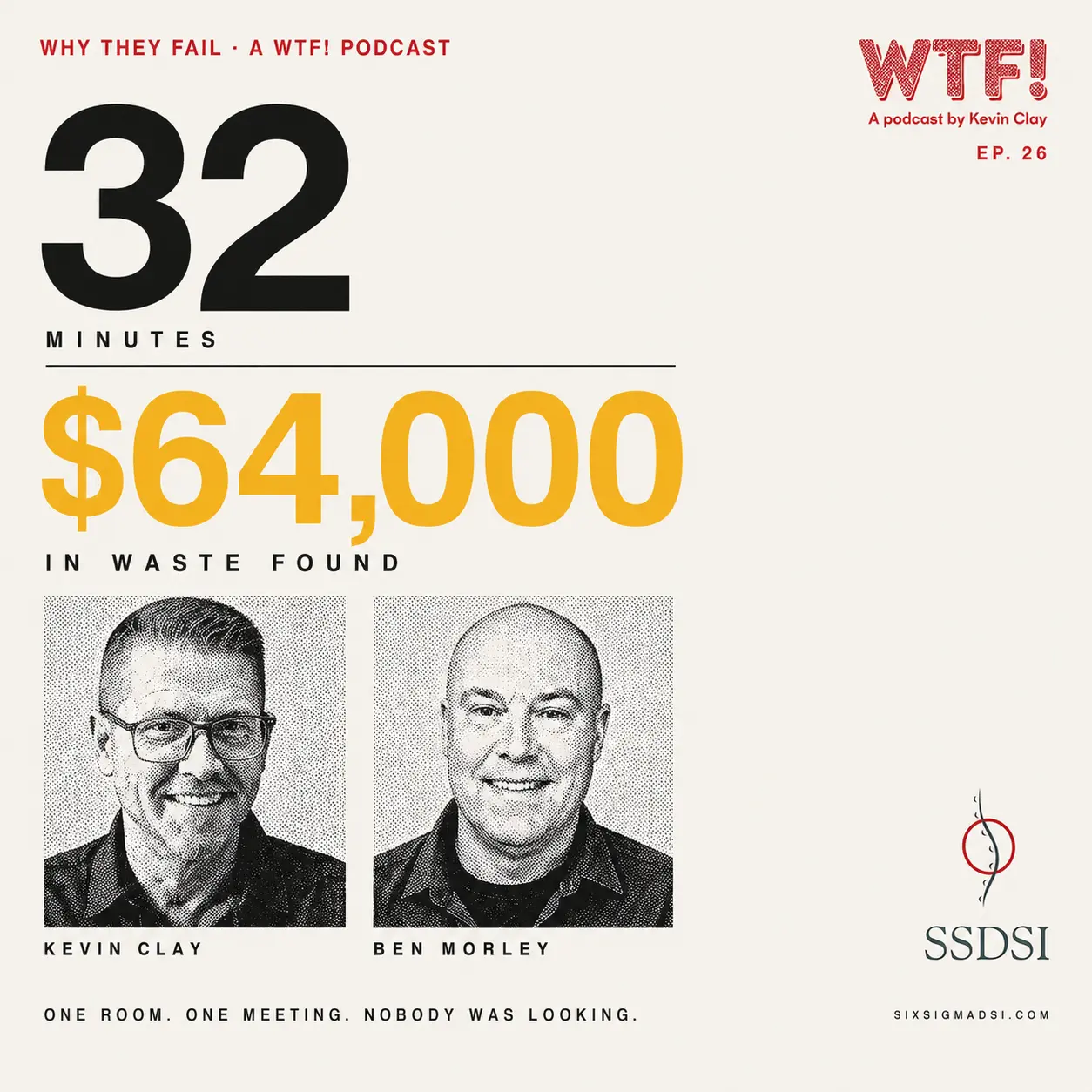
Today we are diving into how simple targeted process tools can reveal massive financial savings hiding right in plain sight. Joining me today is Ben Morley, a former senior air force officer, C17 instructor pilot, and squadron commander who flew extreme polar supply missions to McMurdo Station in Antarctica. After translating high stakes military checklists and extreme operational discipline into corporate strategy, Ben became one of our top continuous improvement consultants and instructors, helping companies streamline workflows and eliminate operational friction worldwide. In this episode, Ben shares how flying cargo jets on ice runways taught him to spot communication silos, kill scope creep, and help a corporate team uncover $64,000 in hidden process waste in just 32 minutes.
[00:02:15] Speaker C: Ben, so what was the catalyst that got you into the continuous improvement, this awesome methodology?
[00:02:22] Speaker A: Well, I have to confess, I was one of those disinterested guys looking in on a class and I didn't want to have anything to do with it. So with my time in the Air Force, they had these programs as classes called Enterprise Value Stream Analysis, which was the military likes its acronyms and that's what they were calling Lean Six Sigma. And I would watch a gentleman in a classroom with butcher block paper posted all over the room with a room full of airmen who clearly did not want to be there.
I'm like, I don't know what's going on in there, but I didn't want to have anything to do with that. And so when Those classes would come in the door, I'd go out. I had something else to do. And so the flip happened on a mission over the Pacific Ocean with a buddy of mine and we're heading to Hawaii and we're chatting there, flying over the Pacific. And he's telling me that he had taken that EVSA course, that enterprise value stream analysis course at another base. He had never finished his certification project he was supposed to do and he never thought much of it. Well, then he later on goes and joins Microsoft and he's sitting down with his mentor one time and casually mentions that he's taken this lean Six Sigma class. And his mentor stops him cold and says, do you understand how seriously Microsoft takes continuous improvement? Do you actually understand what you had?
My friend realized he hadn't. So that story hit me differently on the flight deck at 30,000ft. So the next time that EVSA class was offered on the military base, I signed up.
[00:03:42] Speaker C: What was the absolute catalyst over the Pacific that flipped you from actively avoiding butcher block paper continuous improvement classes to jumping headfirst into a lean Six Sigma path? We just covered it a little bit. But give me, give me some more context.
[00:03:57] Speaker A: The context was that finally there was an outside source of an organization that was adding value to what was actually going on in the class. I didn't know what was going on. We tend to be a bit sarcastic in anything we didn't need to do or we weren't going to do. But the fact that my buddy had told me that re caged my perspective on what was going on in that class. And maybe I didn't know as much as I thought I did or what I thought I knew I did. I'm like, okay, I need to plug in and find out more and what's going on here. Because when you have a powerhouse company like Microsoft politely correcting my friend. Well, I fit in that same category as well too, because I'd never been in the class. I'm just judging from afar and what I think I know what's going on. And now we can. With the classes that we've run and we've seen with the people sitting in the back with their arms crossed so they think they know it is because Billy down the hall took a class like this back in College, back in 1984. Nothing's ever happened, therefore I know exactly what's up. And I was of that same ilk, if you will, is. So it changed for me because a third party Microsoft outside of the military took it very, very seriously. And they Implemented all the time. And so that got me to rethink it and that led me to join in the class. And that time it came around.
[00:05:07] Speaker C: Do you use method that you learned in class? Did you use this in the Air Force? Did you apply these things?
[00:05:14] Speaker A: I did. So the next time that class came around and it was their version of a lean six sigma green belt class and there's 34 of us in the class and I paid attention because I now had that story with my friend. And out of the 34 students, only one person completed a project and got certified and that was me. And I'm not trying to say I was any different than anybody else in the class, but because largely the point was 33 of them scoped it too large. Like you had a guest in a previous conversation on a previous podcast. We want to solve homelessness in Los Angeles. Noble, great. But that's not going to work with a project right here. And so scoping was a big deal. There was no guidance. Some people didn't even pick a project. They just sat in a three day class just to get out from the office. Some just were doa, leaving the class. Other ones picked way too large a product. We spend so much time speaking with students about boiling the ocean, as I've learned from you. And so we took small bite sized projects and that's what I did. I had three and two weren't really great, but one was really good and I made an A3 and I submitted to the Air Force and I got certified. It's still probably on the Air Force portal. My very first project and I got certified, became a green belt. And it was the analogy of a pilot flying a mission. You don't fly the whole mission at once. You break it up into legs, into segments. And. And that's exactly what I was doing with the project. You can certainly take on a gargantuan, very large project tied to KPIs with your company, but break into small segments. And that's exactly what I did to learn how to utilize the tools on a micro level to create a macro result.
[00:06:49] Speaker C: In the class we talk about scope when you're looking at the charter and I say that most students are looking at an elephant, but they're looking way down a hallway at a really tiny elephant. To them it looks very easy to get a hold of. Then they start to walk up on it and it gets huge and it gets gargantuan. I tell them in what you and I do, Ben, there are three really important words when it comes to scope. And I tell them that if I tell you my Lean Six Sigma practitioners are probably going to ostracize me because I'm not supposed to be telling you this. And they kind of giggle and I say, okay, so I'm going to tell you the first one. The first one is focus. And they say, okay, all right, focus.
And then I say second most important word. So much more important than the first word. Drumroll. Focus. And they go, what? Right. And then I say the third word, the most important word. Can anybody guess what this is? They all say focus, right? So the three words that are really important are focus, focus, focus. Those words sound the same, but they're not. They're just different levels of focus. We tend to focus on the big picture and try and solve the big puzzle. But you and I use the tools like the Pareto chart to get down to that 20% of that focus that we really need to focus on. The other funny thing about this is your leadership will look at that small focus and they'll say, well, that's too small.
You're not going to gain anything from that. That always lets me know there is no structure in place. Because if they really understood that solving that small focus, we could then translate that to every other process that looks like it. It becomes a huge focus.
[00:08:30] Speaker A: That's so well put. And it can be so exposing to somebody. Why are you focusing so small? Okay, you're telling me a lot with that comment, but now I know what we're dealing with. You've taught me, and I use it to draw a physical box on the board or on the paper, on what's in the box and what's outside the box. This is our scope in the box. And we all agree with it on day one. This is our scope now if we need to amend it at some time for some reason, we will all get and meet and we will agree on it. But boy, oh boy, scope creep is huge. And if your champions the creeper tell him no. Him or her no. Politely, respectfully, but no. That's another project for another time. And yeah, because I think you said it's directly proportional. The scope and the duration of the project are directly proportional. If we just add a little here and add a little here, it becomes the Never Ending Project. That's a very bad movie. It went straight to video. You don't want to watch it. Don't watch the Never Ending Project. And there's lots of them, and they're in the file drawer in Billy's office over here. Right from the last guy that came in. Never ending. Don't watch a never ending project. Small bite size. And to your point, as we've learned, that can help with the belief with maybe some people who are on the fence, is this going to work? Get a quick win. It's a small one, maybe it's a Kaizen event. It is small, but it creates that belief and it creates that, that escape velocity from the mindset that we had three weeks ago before the consultant came in. Okay, so now I can uncross the arms and I can be more for the next version.
[00:09:59] Speaker C: How did landing heavy cargo jets on ice runways in Antarctica teach you to spot the severe operational friction points and siloed communication blocks? Within corporate culture, you got the opportunity
[00:10:12] Speaker A: to fly missions to McMurdo Station in Antarctica. It is not a normal mission by any definition. Almost every standard procedure that we had in the jet C17 got modified for the polar environment. Fuel temperature had to be continuously monitored, even with special cold weather additives. If the temperature approached certain limits, the fuel could begin to coagulate, lose viscosity and essentially start turning to slush, which is not a good thing. So we had to descend, we might have to descend to a lower cruise altitude mid flight just to keep the fuel flowing. Navigation is different down there. Magnetic compasses become unreliable near the polar regions. And so we operate in grid navigation mode. Everything is modified, everything has a tighter margin. And that's before you factor in that Antarctica is the coldest, driest, windiest continent on Earth. And it is not a forgiving operating environment. But the biggest factor was the weather. And I mean, it was the biggest factor by far. The weather at McMurdo had to meet specific criteria before we even were alerted to leave the hotel. Then we had to check it again before engine start and then again before departure. And then every hour on our way down on the flight. It's a five and a half hour flight one way. And if the conditions degraded outside the acceptable limits on arrival, we could not land. We turned around and flew the whole thing in reverse. We called that a boomerang. So you might spend 11 hours in the jet, not land anywhere and go right back to where you started. The weather can change in 20 minutes. We could be monitoring it. You'd be doing everything right.
And here's what makes that harder than it sounds. The nearest alternate airport was 2,100 miles away. It's not just over the hill in the next town or city and that's across shark infested ocean. There is really no Divert field. There is no plan B Runway. You either land at McMurdo or you fly five and a half hours back. So you could execute a perfect flight, arrive overhead and have the weather deteriorate out of 20 minutes, entire mission gone. And what made all this manageable was communication. Constant, accurate and timely across a remarkably dispersed network. Our weather data was coming out of South Carolina. We were coordinating with the McMurdo ground team, with the US Air Force and with our departure team back in New Zealand from Christchurch, where we took off from. So multiple agencies spread across the globe, all feeding into one mission. Every handoff had to be clean. Every update had to be timely. There was no room for a silo. And then I walked into my first corporate client and I saw the exact same communication breakdown, just without those immediate consequences. Nobody boomerangs home when a department stops talking to the one right next to it. The consequences are invisible until suddenly they are not. I worked with a company trying to improve their on time delivery metrics. They were hovering around 59% when I started mapping the process, I discovered that workers routinely were not clocking out of jobs when they finished them. So the team was doing retroactive guessing, manually dragging jobs through the system after the fact. The data that existed was likely inaccurate and the data that should have existed simply was not there. You cannot improve what you cannot measure and you cannot measure what nobody recorded in Antarctica. Those friction points simply cannot exist. The training standards, the communication protocols, the real time KPI monitoring, they eliminate it by design. And in corporate culture, those same friction points can hide in plain sight sometimes between two departments that are literally separated by a single wall. They might as well be at complete polar opposite regions.
[00:13:55] Speaker C: Ben, you have taught several classes for us. Ben is one of our very skilled and very charismatic teachers that we send out to engaged companies all over the world. Ben told me a story about one of his, his first engagements that we sent him on for a fresh black belt. Sitting in a rental car outside of a client's building with sweating hands and a full blown imposter syndrome. Because I think this is one of your first engagements. What was the secret to really finding your sea legs in that first 20 minutes before you went in?
[00:14:29] Speaker A: Boy, I tell you, sitting in that rental car with those sweating hands. Yeah, the imposter syndrome. I'm asking myself, what am I doing here? I'd been a senior Air Force officer, instructor pilot, commanded a squadron, led teams globally, and I'm sitting in this Dallas parking lot about to walk into an eye clinic and teach a multi day Continuous improvement course to a room full of managers. I am multiple standard deviations away from my comfort zone.
And it's. It was our client. I'm new in this relationship with Kevin, and I'm like. I'm sitting there genuinely wondering if I just drive back to the hotel and make up some story that I couldn't find the building. Well, clearly, I couldn't do that. So I walked in, and here's what that taught me. In those first 20 minutes, I reminded myself that I didn't need to know everything.
Eye clinic. What do I. What do I know about an eye clinic? I knew I had imposter syndrome, but I also knew I'd spent decades leading teams in some of the most unforgiving environments on Earth. So I followed our checklist. I lean on the core structure, the way a pilot leans on standard procedures when the pressure is on. And then something shifted. Felt mechanical, I suppose, at first from working through the modules, hitting the slides in sequence. And then as I was doing an introduction of who I was and I mentioned I'd been in the military, found out there's a couple of veterans in the room. Small connection, instant win. I started warming up, and then the slides became a script. Then rather than a script, they became a backdrop. They became more of a backdrop. I started pulling in my own stories to illustrate the concepts, and heads began to nod. Questions came in. We hit a planned break. I met a few people, and when we came back, I'd found my rhythm. And the secret to all of this. I stopped trying to be someone I was not. I brought my experience to the data, and I made it my own. 20 minutes. That's all it took.
[00:16:11] Speaker C: I can tell you that I've been doing this for over 20 years, and I get those butterflies every time I go in. Even though I may seem like I know what I'm talking about. You're always walking into a new environment, having that experience and your experience and your background. Those butterflies only last a minute when you start calling on what you know. That's awesome. This eye clinic, by the way, who gave you raving reviews, which was awesome as well. When your students at that Dallas eye clinic accidentally bypassed Leviathan problem and stumbled into a $64,000 savings bottleneck in under 32 minutes. What did it teach you about the real power of just simple visual tools?
[00:16:55] Speaker A: Phenomenal. And it sticks with me to this day and what makes me passionate about what we do. So here I am at that same eye clinic with you, like you said, and we found a good rhythm I'm teaching a concept. The class breaks into their five groups of managers to apply it to a real project. They brought with them projects that we vetted that side to company KPIs. They apply it to their project. Then we reconvene, I teach the next concept and we keep that cycle going. Teach, apply, teach, apply. And I just finished teaching a segment. We, the groups were in their breakouts, applying that latest tool. One group waves me over to check on their progress. And what they show me has really nothing to do with the main project they came to class with. As they were working through that particular tool, they had stumbled across an issue in their company's delivery process. Lost packages, delayed shipment, pickups, rework, an Easter egg hiding right there in the data. And this was not their assigned project. This was something the tool surfaced that they had not even been looking for. So they kept going. They identified root causes, they discussed countermeasures in real time. And then one of them looked at the financials of what fixing this problem would mean to the company. 64,000 minutes on a problem they were not even trying to solve. They're looking at me and I'm looking at them, and you could see it happening in real time. The moment the methodology stopped being a classroom exercise and became something they owned, they did not need my validation anymore. They had found the problem, applied the tools, done the math, and arrived at a solution completely on their own. I joke that I could have gone back to the hotel at that point. They didn't need me anymore. My work was done. But what that moment taught me was this, is that the power is not in the complexity of the tools that we use. It is in what simple, well applied tools reveal. That was always hiding in plain sight. That team did not walk in that morning knowing they had a $64,000 problem and the tool showed it to them in 32 minutes. And that's why I love what we do.
[00:19:01] Speaker C: I go into companies like you did and teach these methodologies and using this as well. When the students come in with a defined charter and they come in with data, a lot of times these companies have so much data that they really get analysis paralysis. They don't look at it. Everybody looks at their own experiential learning, make judgmental decisions because data is there, but it's really outside of their reach. They come in with data and it's almost like a magic trick. We start in the defined phase and the measure phase, and then we look at a process that they've never looked at the Statistical control of the process. They just say, if it's bad, we fix it. Or then everyone says, there's really nothing wrong with this process. Then we look at it through tools like the IMR chart and we say, wow, this is all over the place. And there are all these trends happening, and then it starts to wake them up, go, I know exactly what happened there. But I don't see that in real time like this. Then we move into the analyze phase, and everybody wants to analyze with things like the fme, the easy, quick tools. But those tools, if five teams were working on that same tool on the same problem in different rooms, segregated, they'll come up with five different results. So we kind of push them to data analysis. And if they come in with data, like a magic trick, we start to show them through things like regression, multiple regression, and then input star signals start to show up. Most of these people, 30, 40 years old, have never ever seen that. They're so enamored with tools like Lean, which are very tactile tools, very easy to see. But when they start looking at data analysis and the rigor of data and see these signals showing up, it just blows them away. That's what I love to watch in the class. People go from very much being against data and data analysis to very much being like, wow, how do I do this? How do I get to know more about this? That's kind of what you had in that class. You saw the light come on. That's my favorite thing to see happen in a class, is a light that comes on.
[00:21:10] Speaker A: Totally agree. Piggybacking on your point. Did this with a company here locally. They needed to improve output. They were at 32,000 units a month. They wanted to get to 50,000 units a month from their larger international customer. They had used brute force management their term to try to get to 50,000. They were getting a sugar high. They get it up into the 40s and then regressed back down to 32. I came in using the tools we had, and as I was working towards seeing they could actually make 50,000 work as wrapping up the project, their customer moved the goalpost to 60,000. Can they go from 32,000 to 60,000? And they could. And with all the tools and everything that you just mentioned, I showed them statistically, no change manpower, no change in equipment. There is enough variation in your process. You could move this from 32,000 to 60,000.
Same people, but using this, this and this and that was going to equate to $1.12 million of revenue monthly for the company.
[00:22:09] Speaker C: That's amazing. That's pretty normal in what we do. It comes out of everything because the capacity is always there. And that companies, they want to expand, they want to hire more people, they need more stuff. And then you go back to them and say you really working to about 15% of your capacity, you've got 85% just out there waiting for you to grab. And they look at you like you're smoking crack until you teach them the tools to actually grab that capacity. Talking about that, I'd like to ask you a really cool question about why pilots handle ground operations differently than flight operations. That kind of plays on the things that we talked about so far.
[00:22:47] Speaker A: Yeah. With your and my common background. Anybody listening? You ever notice how obviously we can move pretty fast through the air fighters, all sorts of different aircraft, but boy, on the ground they tend to be pretty methodical, pretty slow because we have taxi, we have radio frequencies, we have handoffs. There's the configuration. Everything on the grass packed with risk. You have tight spaces, there's limited margins, wingtip clearances, ground equipment, other aircraft moving around. So we can treat this with extra discipline on the ground, not less. You would think the flight's over. No, no, the flight's actually not over. We slow down the work and we do so for multiple safety reasons. However, when you look at it with a company, sometimes many leaders may do the opposite. They bring urgency, speed, improvisation to onboarding, or the cross functional handoffs, or the planning and the routine setup work. Hurry, hurry, hurry, let's get it. Then they wonder why execution gets messy later. Well, the issue is simple. What looks like admin is often mission critical surface work, just like with moving an aircraft out to departure or after landing and moving it to the gate. So three aviation inspired moves to help leaders treat ground operations with the respect they deserve, if you will. Number one, slow down the work that creates the conditions for speed on the ground. Pilots don't confuse motion with progress. There's hazards everywhere. Like we're just talking about role clarity, onboarding, decision rights, configuration and sequencing should not be rushed. Slow those moments down on purpose because that is where preventable friction usually begins. And number two, use explicit handoffs instead of assumptions. Back to my polar opposites. Remember, values are your belief. Culture is your behavior. You speak so much about culture and that's so important. Values is what's on the webpage. Values is what you have on the posters down the hallway. That's our values. It's people first transparency, all this. Okay, that's the easy part. But if I walk around your people, do I even feel that in your culture, values are belief, but culture is your behavior and culture matters so much more. But if I don't feel any of your values running around with your people, those values are just words on a page. It's a banner on a website. It's a glossy in the waiting room. All of this needs to be done early to make that when your culture does become your values, you can go from good to outstanding on a very steep curve. So number two, use those explicit handoffs instead of assumptions. Aviation ground ops depends on clear acknowledgment. Who has control, who is moving, who is waiting, who is cleared for takeoff. Leaders need that same rigor. Don't assume another team member understood the dependency, the timeline, or the ownership. Make those handoffs visible. Our process maps is a wonderful tool. Just like what you talked about, right? The union guy sitting in the back row. I didn't know you do and you go to the same copper, that sort of stuff. Make the handoffs visible, confirm it, reduce the space where confusion can hide. And number three, treat checklists as performance tools, not bureaucracy. Pilots use checklists because routine does not mean safe. Flew the jet for a number of years, but we always, always, always look at the checklist. Familiar work still fails when people skip steps. Leadership is no different. Hiring, onboarding, planning cycles, stakeholder alignment and operating rhythms all benefit from a repeatable method. Use those checklists to protect quality, lower those avoidable errors, and free up attention for the work that truly needs judgment.
[00:26:13] Speaker C: It makes me think of what we talked about here. Why pilots handle ground operations differently from flights that companies don't plan or they skip over the ground operations. Because I have KPIs. I may have a mission, I may have a vision, but my people on the floor don't know what it is. They never seen it. You ask on the floor, what is your mission or vision? They'll tell you to go talk to their supervisor. You ask them what their KPIs are, and again they give you blanks. There's. I think it's very important when we improve our process that we start off from building the structure, the infrastructure before we actually go in to flying. That's like you getting into a plane from Tac Air and just flying without first going in and getting your flight plan and going through your checklist three or four times. Because those that go through those checklists probably are alive. Pilots, you have to have that structure in place. What I see is a lot of companies call us wanting to train green belts and train practitioners, but they don't have an understanding of those ground operations. They don't have an understanding of what's our mission, what's our vision, what's our strategic goals, what's our KPIs? What are the KPIs that cascade down to the person so that everybody understands exactly how they are affecting the company? What it is is we develop KPIs at a top level and everybody below that is running around like lemmings trying to affect something and they're not really sure what they're trying to affect. I love that analogy of handling those ground operations because that really allows you to fly.
[00:27:51] Speaker A: Exactly, precisely. And there's tools for us to come in and help them out. Okay, well, we hear you, Kevin. Well, what do we do? Leader Standard work Toyota Kata the morning walks. Do you ask question? Do you walk at the same time? Do you go to the same state? Do you ask the same questions? Do you do a quick root cause analysis? If something happened, do people know that they can raise their hand and ask a question? Do they know that that's not going to change overnight? You're right. Sometimes I get a pat on the back. Sometimes I get yelled at. I don't know. I just make widgets for eight hours. That's all I do. When I go home and watch the game, how do I include them? And to create that culture, it's going to take a little bit to turn the QE2. It's not going to be done on a dime. But if we work with the leadership and that's so clear with everything I've learned from you. And when we go and work with the company and if we check with the executives first, do you know what we're doing? Yeah, yeah, yeah, yeah. I took a class like that back in. Okay, all right, I see what we're dealing with.
[00:28:39] Speaker B: Thank you so much for listening to this episode of why they Fail. We covered some powerful takeaways today including why focusing your scope on tight manageable project legs prevents scope creep, how aviation ground ops discipline can eliminate corporate silos flows and how using basic process mapping tools can instantly surface high value cost savings. If you want to dive deeper into these methodologies, make sure to grab a free PDF copy of my book why they Fail and the simple key to success using the link provided in the show notes below. Subscribe to our YouTube channel as it is a completely free way to support what we do and stay connected with with our latest visual content. Make sure you are also following the podcast on both Spotify and Apple, so you get every new episode instantly the moment it drops. If you found value in today's discussion, please leave us a five star review as it helps other business leaders find the show.