Episode Transcript
[00:00:00] Speaker A: If our instinct or our action and reaction is to start asking who screwed up? That blaming and shaming and punishing approach is only going to teach people to hide problems if they can get away with it and we again can't solve problems that we're not aware of.
[00:00:20] Speaker B: Welcome to why they Fail, the podcast that pulls back the curtain on why continuous improvement efforts fail. Buckle up because we're not here for motivational fluff. We're dissecting the short sighted decisions and leadership agendas that sabotage CI success. But don't worry, we'll clue you in to the few simple keys to success to avoid these pitfalls. If you're ready for the truth, let's do this.
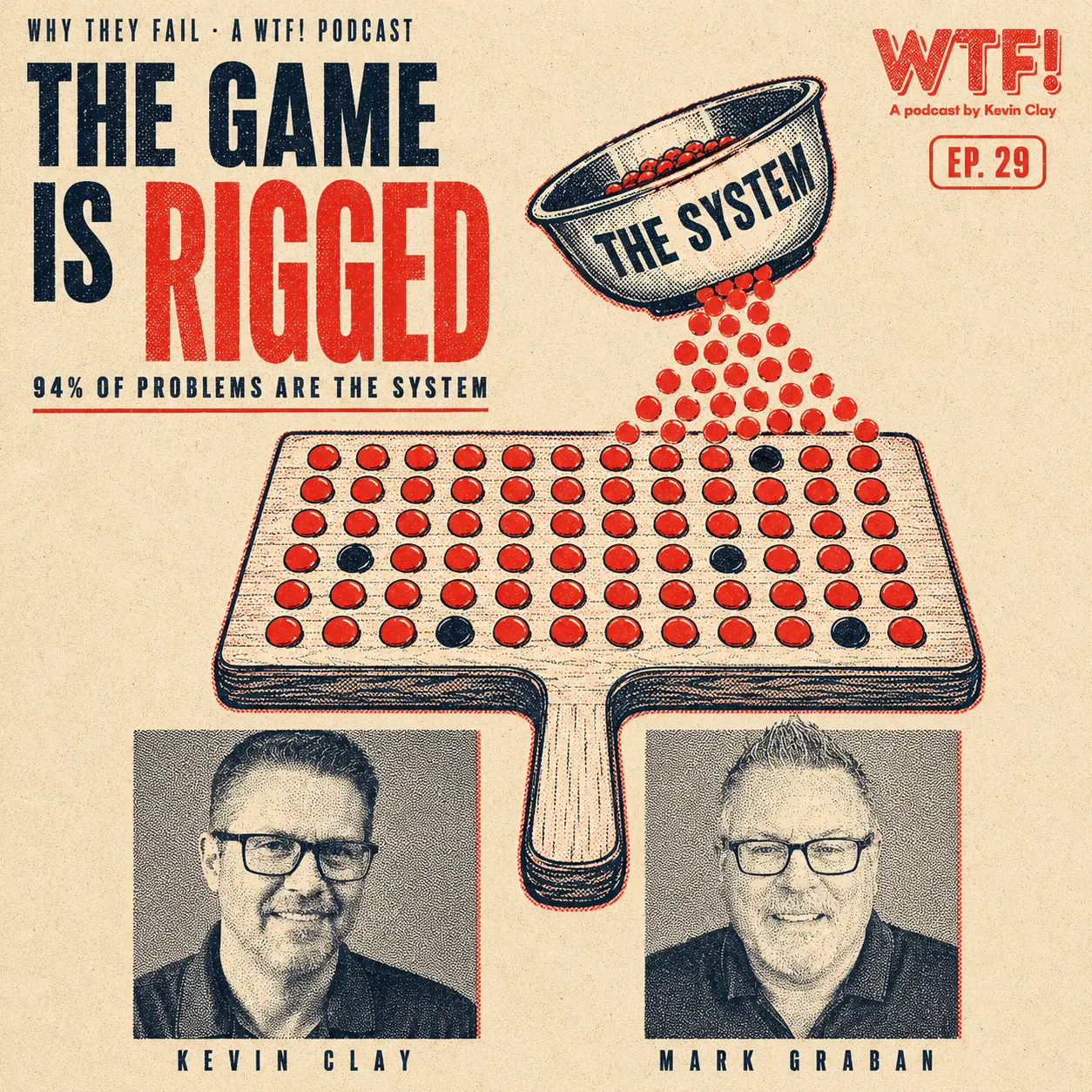
[00:00:53] Speaker C: Welcome to why they Fail when continuous improvement initiatives collapse, leaders almost always point the finger at frontline employees instead of looking in the mirror. Today we are joined by Mark Grabon, an internationally recognized author, speaker and continuous improvement consultant. Mark holds a Bachelor of Science in Industrial Engineering from Northwestern University, as well as a Master of Science in Mechanical Engineering and an MBA from MIT's Leaders for Global Operations program. He started his career at General Motors, lived through the stark contrast between traditional management by fear and Toyota style leadership, and has authored landmark books including Lean Hospitals, Measures of Success, and the Mistakes that Make Us. He also hosts the popular Lean blog Interviews podcast and has written extensively on creating cultures of psychological safety, root cause, problem solving, and error prevention. In this episode, Mark and I break down Dr. Deming's rule that 94% of problems are systemic, why treating Lean as a mere cost cutting tool backfires and how leaders can stop blaming workers for mistakes to finally build high performing resilient organizations.
[00:02:07] Speaker B: Mark, what was your catalyst? What got you into continuous improvement? What started your journey?
[00:02:14] Speaker A: The short answer is my first job at General Motors. Now someone might be scratching their head and say, okay, well what did you learn about Lean at General motors? Well, in 1995 I learned a lot as we'll talk about here today, about what not to do and some things that were better. There's a really interesting case study to live through there, but the longer version of the answer is I'm an industrial engineer. In my industrial engineering classes there was kind of in the introduction to Operations 101 mention of Toyota production system, I'd say what was taught was correct and really helpful but not the full complete picture. Toyota was being framed as production and material flow. Important but not so. It was really more about the mechanics and the math of looking at pull versus push and limiting WIP within a system. And great Concepts like that.
The other dimension, the other direction I came at this from was being exposed to the work of Dr. Deming W. Edwards Deming. Because my dad had a copy of out of the Crisis on the bookshelf, I think we can talk about that more. The motivation factor though was seeing, especially in that first year at General Motors, how basically people hated coming to work hourly and salaried alike. Hourly workers had. They were the ones with the golden handcuffs. They all had 30 or 35 years seniority and their union benefits and they were just going to ride it out the best they could to retirement. It made no sense for any of them to quit and leave. Within the salary workforce it was a different dynamic. People hated coming to work. Performance was abysmal. Not because of bad workers, not because of the union. But I would argue as a lot of others would, because of the old kind of broken GM management model, bad quality, bad productivity, bad morale, really served as like this inspiration that whether it's today in a factory or in a hospital, I would want the same things to apply. You shouldn't hate coming to work. You should be treated respectfully. And leaders should help put systems in place that set people up for success but allow us all to participate in improving what's hopefully a fundamentally good system to begin with.
[00:04:34] Speaker B: You have a unique foundation rooted deeply in the philosophies of Dr. Demening. Before you ever encountered Toyota based link, can you share that initial catalyst including your father's influence at General Motors and how reading out of the Crisis shaped your early perspective?
[00:04:51] Speaker A: Yeah, it was an admittedly weird thing for a college student to be reading. Probably a copy of out of the Crisis with Deming's head on the COVID and everyone here.
[00:05:01] Speaker B: I'll put the link to it in the show notes. Yeah, yeah.
[00:05:04] Speaker A: In that operations 101 class we did read the Goal. That was the first of many times I had that book thrust and said you need to read it and we're going to try to learn from this. That even happened in what I call bad first year at General Motors because boy, there was a constraint that needed to be worked on. You think about Goldratt and theory of constraints as a framework. My dad retired after 40 years at General Motors. He was an engineer with an mba. He was never really a plant manufacturing guy. He was in product development or service technologies the dealers and service people would use. So he had a different day to day GM experience than I had. But part of the experience and the opportunity he had as somebody who was statistically minded, he has A master's degree in statistics as well. He got invited to participate in the famous Deming Four Day seminar. This was probably in the late 90s when I was in high school.
And it made an impact on him. He kept the book. It was on the bookshelf. My curiosity remember picking it up and asking him about it. One quick story I'll retell on my dad's behalf is, and I've heard similar stories from other people, companies like GM and Ford would send dozens or more people to a Deming workshop. They probably weren't sending the right people to the workshop. So the story, as my dad recalls it, is at the end of the four day Deming seminar. It might have been the last hour or so income the Cadillac executives to come take their reserved seats that were either in the front row or up at the table.
They kick it off and leave and then come back to wrap things up and I guess get a pat on the back for sponsoring the seminar. And surprising to Anyone that knew Dr. Deming's work and approach, he spent a good amount of time chewing out the executives. You should have been here all four days. And he had a point. Right. One of the key lessons from Dr. Deming is that whatever number you want to put at it, 94% ish. 94% of the problems in a system, in a workplace are the result of the system where I think most workplaces even today will flip that and they'll want to blame employees for everything. That was certainly. That was the old sad GM mindset that happens way too much in healthcare here in 2026. The system that includes high level decisions that frontline employees have no control over. What suppliers are we choosing? What is our management system? Things like that have a huge impact. And Dr. Deming said, well, senior leadership is really most responsible for the system. So we could play the red bead game all day long, which I love it. I have a red bead kit in the.
[00:07:54] Speaker B: I love that game. And it's so much about what you're talking about, the system and how anybody can come in here and you can praise people for pulling less red beads and then ostracize somebody for pulling more red deeds. But they can't help it. It's in the system.
[00:08:10] Speaker A: Right. If you're running the seminar or doing the red bead game for an audience that will relate to it because they suffer from that system and they're not the ones that can change anything. Why are you teaching them the workshop? You want the lessons to come out around thinking back to various points from Deming's 14 points, like stop relying on slogans, stop relying on targets, stop trying to inspect quality into the product or the service.
Stop overreacting to noise in a metric. These are lessons that senior leaders need to learn. And if they're not willing to come and be part of the class, part of me wonders, well, Dr. Deming, why'd you do it? I figure it's some point you teach the people who are there and maybe someday they're going to be a senior leader. They can have that kind of influence. I think of the lessons from Dr. Deming not only being statistics, but a lot about psychology.
I love Dr. Deming's lessons about not destroying people's intrinsic motivation. Dr. Deming called the forces of destruction. And a lot of these things are kind of typical MBA program management techniques. There's a long list of lessons that
[00:09:24] Speaker B: come from I go into companies all the time and they're still breaking all those rules. They're still doing things that are completely against that. They have slogans on the wall. I love my employees, our company's great and all the while we're going under. There's not a lot of emphasis put on a culture, more of hitting numbers right.
[00:09:44] Speaker A: And it's short term focus versus long term focus. For people who are familiar with the Toyota Way framework, like Jeffrey leiker's book, also 14 principles different than Deming's 14 points. Point number one of the Toyota Way, I think I'm paraphrasing this very closely, is the importance of making decisions based on the long term perspective, even at the expense of the short term. That's so close to what Dr. Deming taught many organizations, because of whatever outside pressure they want to blame or just their own internal mindsets, they're so short term focused they'll make sub optimizing decisions that end up holding the organization back. These Deming lessons are so powerful, I would never reduce him to say he was a statistician. I think he was just a broader great leadership thinker.
[00:10:36] Speaker B: He thought about the culture, he thought about the people. He thought about building a company using your people, not banging on your people, was the statistician. He understood data has its place in improving the process. But sure, when you're completely focused on data numbers and you don't really understand the culture, you're going to sink a company. I thought Deming was way ahead of his time and I try to think that way every place I go.
[00:11:01] Speaker A: Yeah, it's sort of a gift to learn these ideas. But then the challenge is that it really. It puts you out of sync with a lot of these organizations that we go in and try to work with. Some of these fundamental mindsets really get in the way of talking about how are leaders treating people on a daily basis. And this is something we're going to come back to later about mistakes. Some people are just so deeply convinced that we have to punish people for making mistakes.
[00:11:29] Speaker B: When I teach in class, I talk about where the problems come from because we use tools like fmea, stuff like that.
There's a certain place where we have a cause, or 90% of the time, that cause points to a person.
[00:11:43] Speaker A: Yeah.
[00:11:43] Speaker B: And I back off and I say, we need to play that red bead game, because you'll learn something. 99.9% of the time, it's not the person that causes a problem. They don't go into a job wanting to make a mistake. It's you as a manager. I'm talking to my colleagues, my students, and I say it's you as a manager. You created a process to where there are way too many decisions to be made. You created a process where it's cultural learning, where Jimmy teaches, John teaches, Jack. Like the telephone game. Over time, it becomes something that everybody does differently. There's no choice but to make a mistake. I'll give you one more example.
Some companies I've worked with for several years, and I was in one company actually saw somebody, was hired, and then they made some mistakes.
They were called out in the management meeting, and eventually they were fired. And then another person was brought in to do the same thing. Guess what? Same thing happened.
Finally the third.
[00:12:39] Speaker A: Yeah.
[00:12:40] Speaker B: It's finally the third person. They started to understand, hey, wait, maybe it's not the person that's doing this. And that's really when they have the epiphany of looking at operational metrics.
[00:12:50] Speaker A: Yeah. And the cost of that lack of understanding or the cost of that misunderstanding is really high.
[00:12:57] Speaker B: Yes. But if you have that understanding in the beginning and you keep saying that mantra that it's not the person, it's not the person, what isn't in the process that's going wrong and never looking at the person, then you all of a sudden cross a chasm to where now you're looking at your processes and you're putting capacity back into your processes instead of switching people out. Right.
[00:13:20] Speaker A: Yeah.
[00:13:20] Speaker B: All right. Excellent. Your early career at GM exposed you to a traditional management my fear environment, followed by a manager from the NUMMI plant. What did that immediate contrast teach you? About how leadership behaviors dictate operational results.
[00:13:38] Speaker A: It was a very clear before and after compare and contrast set of experiences that I had at that GM plant. It was an engine plant, not a car assembly plant. We were making V8 engines for, for Cadillacs and for a certain Oldsmobile. These were expensive cars. These were supposed to be premium high tech engines. We were supposed to make about 800 a day of, of of these engines. So pretty short tack time, relatively high volume. The plant was really struggling. It was just this dark cloud that hung over the plant and over everyone's head. It was just a pretty miserable, low performing environment. Management would just yell and scream and blame and chastise people for the productivity problems, for the downtime, for the quality issues. Having early exposure to Dr. Deming, you start seeing the real life examples of what was in Dr. Deming's book. One example would be again, short term, thinking of you have a machining department doing engine blocks, that's behind schedule. You're causing problems downstream. So then managers jump in and say, we can't afford you to take time to change your tools, the tooling and the bits. But they're supposed to be changed at a certain frequency for the sake of quality and the tool life and what have you. And the workers might try to say, no, that's a bad idea. They of course they get overruled by management. And then wouldn't you know, some catastrophic failure occurs. And now that machine, instead of taking it down to do the tool change or doing a project to reduce the amount of time the tool change took, classic Toyota setup reduction kind of activities, this thing would blow up in everyone's face. And management never really ever said, oh yeah, our bad, sorry we made that bad decision. They were excused for their management mistakes. Mistake. But God forbid, if you were an employee and you made a mistake, I mean there was this huge double standard and there are similar stories that led to huge quality problems that were absolutely caused by bad management decisions, short term management decisions. Of course workers get demoralized and discouraged. I never saw anybody sabotaging anything, but I understood why. You read stories about that in the GM history of workers being so discouraged that they're literally leaving loose bolts or empty beer can inside a car door so that it rattles and pisses off the customer. I understand what might lead someone to get to that point out of just the frustration and the futility. So what I saw, not to oversimplify it, is that old GM management style of being the all knowing command and control boss, yelling and screaming and blaming and like that, that didn't work. Not only did it not work in our plant, like our plant was the worst performing plant in the auto industry when it came to quality and productivity. That first year was very frustrating. I'm glad I didn't quit. I started interviewing for other jobs. I thought, this is not a place I want to be. This is not a place I want to be learning from. But then I guess, thankfully there were enough quality catastrophes that GM decided a new plant manager was needed. And enter a man named Larry Spiegel. He was a traditional GM engineer, MBA type. Very similar education background to my dad and to the other plant leaders. But Larry was one of the the first people GM sent to California to be part of the NUMMI launch. That NUMMI plant in California, the long story short is that it was a failed GM plant that was shut down and it was reopened as a joint venture with Toyota. They called it nummi. That meant Toyota was running it. And it was Toyota's opportunity to experiment to see if their management model could work in the US with American workers. And it was an opportunity for GM to try to learn from Toyota. Larry learned a lot from Toyota. And he came into our plant and it was a matter of mindsets. He was out in the shop floor way more than the previous plant manager ever was. And he wasn't out there to lecture people. He was listening. He was building relationships, he was building trust. He stood up in front of an all hands meeting. I can still picture it pretty vividly, hourly and salaried alike. And one of the things he said was the era of blaming the workers for everything is over. We are going.
[00:18:01] Speaker B: That's a pretty big statement, especially when you come from that.
[00:18:04] Speaker A: And he said, we are going to manage differently here and together we will succeed. And he felt confident in saying that because he had played that same playbook at a transmission plant previous to being brought in to come turn around our engine plants. I never read it as him being boastful. It's just he had a plan of how we were going to turn things around. And that really started playing out in that year. I was there. I had a chance to leave and go to grad school. Part of me wishes I had stayed around for another year to have like two years under quote unquote, the good plant manager compared to the one under the old school plant manager. But I kept in touch with people and it wasn't maybe as quick of a turnaround as the new me story was, but within a couple of years, that plant went from being bottom of the barrel to being in the top quartile. Nothing to be ashamed of. It was huge progress. But again, same workers, same products, same equipment, different management style. That's what really made the difference.
[00:19:03] Speaker B: If you were to pick three or four things that really helped that facility turn around, what would you pin those on?
[00:19:10] Speaker A: I think one was the mindset at the top, the impact of that one leader. Sometimes they say, in sports, why do teams fire the coach? I'm like, well, because he can't fire all 47 players on the football team roster. So they bring in a new coach. We had 800 people in the plant. You weren't going to replace the 800 people. And again, most of those 800 people were not a problem.
That new leader with a different mindset, and that starts to cascade and have an influence on others. That was a key thing. Now, I don't want to make it sound like it was all a function of management talk. There was also a lot of embrace of TPS or lean tools. And during that first year, funny enough, one part of GM realized, okay, lean is good. So they hired people from different Toyota suppliers. There was one guy I remember who had been at Nissan, like GM Powertrain headquarters, hired these experts. There were probably seven or eight of them, basically assigned them to the plant. Well, the traditional plant manager wanted nothing to do with these people. They had no mission. They had no.
They didn't have a lot they were being allowed to do. Now, some of them were happy to mentor me. That's part of what I think kept me coming to work in that first year was that glimmer of hope of people saying, here are things that we could do if we were allowed and here's different ways we could be managing. Now, under Larry, that new plant manager, those people were more fully unleashed to say, let's go implementing lean methods, but with the mindsets of the management systems. One example of where I remember seeing a tool misapplied during that first year. Those internal lean experts, if you will, were trying to introduce methods that they thought would be helpful. And one of them, it sounds very basic, is hour by hour production tracking, hour by hour, the maximum. If everything went perfectly, which it rarely did, we would make 92 engine blocks an hour.
90 twos in the column. And then you write down how many were actually produced. And then you were supposed to explain the reasons for a gap because that was supposed to spark problem solving. Two things happened, one that became better data to tell management who they should be yelling and screaming at.
[00:21:22] Speaker B: For the bad.
[00:21:23] Speaker A: You had a bad hour. You're the bottleneck for the plant. And again, it was the blaming. And remember the.
[00:21:29] Speaker B: That's always where they go. Always blaming. I mean, you had the rudimentary tact time thing going on, so you could see things down to an hour, but they still didn't understand that that tells you where there's system problems.
[00:21:43] Speaker A: Yeah. And they would. They would blame people. Their countermeasures that they would bring up were always. I remember when the number two leader in the plant would yell, and he would always say, we need more urgency and more intensity. Like, in his mind, people didn't care enough and people weren't working hard enough. That was very poor problem solving on display. And then the second thing, and this comes back to a Deming lesson, is people learned to start gaming the system and fudging the numbers the best you can. Let's say again, the maximum in an hour was 92. Well, we might occasionally hit 86 if things were really humming. You might have a good hour like that. And then you might have an hour with a 0 or a 4 and 1 point. The team leader for that department learned because he was pretty much told anything below 60 got you chewed out. So he would take the really good hours and borrow from those. And instead of having an hour, he was, like, masking and smoothing out the actual variation. So he would rob 26 parts from the hour of 86, and he would say, we did 60, and then he would add those 26 to another hour to boost it and bring, like, you know, a 45 up to a 71.
It was that lesson again. As Dr. Deming would have predicted, when you set targets that aren't really achievable or all you do is pressure people to hit the target, they may give you the numbers you want, but it really gets in the way of what the real analysis and problem solving should have been.
[00:23:13] Speaker B: Yeah, you can't. You can't really understand what's going wrong if you're trying to game the system all the time because of this. I've seen that in the Deming red meat exercise as part of that, where we game the system and we fudge the numbers. I can tell you, I've seen that so many places that I've gone to, they all have the same characteristics that you're talking about. Management, my fear, people getting yelled at, people getting fired. They have a revolving door. Those things. To me, when I walk into a company, it's palpable. I can see it I can feel, I can smell it. It's almost like you can cut it with a knife. It's pretty obvious what's going on. I always think back to Deming's 14 points and into my mind I'm going, which ones are they breaking? Well, pretty much all of them.
[00:23:57] Speaker A: Yeah.
[00:23:58] Speaker B: Yeah.
You mentioned that reducing lean to just different tools in toolbox is highly reductive. Why does treating lean as a mere checklist or cost cutting tool fail? And what does it mean to build actually a general lean management system?
[00:24:13] Speaker A: That's a great question. I think there are two different questions within the question. Maybe the pull those apart a little bit. One is the problem that comes from viewing lean as a cost cutting methodology that really sells lean short. Even back to my days back at General Motors, the mantra from the NUME trained plant manager was safety, quality, delivery and cost. And that lean helps address all four of those. We shouldn't be looking at the trade offs. The old mindset, the pre Deming mindset would say quality and cost are a trade off. We can't afford better quality. No. When we use lean methods and we're eliminating waste, cost and quality end up going hand in hand. If a company said, oh, we can't afford better safety, well, no, nonsense. It goes hand in hand. And you engage people, especially in healthcare. People working in healthcare don't care about cutting cost. That's not why they get up in the morning. That's not why they come to work. They care about patient safety, they care about their own safety. They care about the quality of the care and the experience experience they're providing. They care about reducing delays for patients instead of just setting targets. When you actually help people understand and improve their processes and the systems and the value streams, you can improve all of those at the same time. And I think ironically get more cost reduction by realizing that cost flows through from improving safety, quality and delivery. That lower cost is a great benefit, but it's an end result. There are so many things people can do to cut costs when that's the primary objective. You can do that in all sorts of ways that harm safety, quality and delivery and employee morale. If you want to add as a fifth letter, one thing I think that goes wrong in a lot of lean implementations is you have old school leaders who are cost oriented.
Any new methodology they learn, they're going to view it as a new cost cutting gimmick. The same I think happens with Six Sigma where IPSO is about reducing variation and improving quality. And how many organizations have just said, okay, Every black belt needs to do projects that save X amount of money. Same dysfunction. That's not the fault of Lean or Six Sigma.
[00:26:27] Speaker B: Yes, absolutely right. In my class, when I teach Lean or when I teach more focused on Lean, we talk about it as a cost cutting tool. And that's just the icing on the cake. I think Lean is really about reducing the complexity in the process. Reducing something that has morphed over time and matured to equal more steps, more governance, more silos. You can take a thousand step process and reduce it to a hundred steps and that's actually not that hard to do. When you reduce it down to that hundred steps from a thousand steps, what have you impacted? You've reduced operating costs because those 900 steps cost something. Then you reduce time, you gain capacity in the process. So now you've got 900 steps worth of time that you can now use to do other value added things when you affect the quality. I talk about quality in the way that Lean affects it. Well, Now I've got 900 steps where I'm not touching the product. Now all the potential for the defects in those 900 steps has went away. And on top of that, the safety risks that happen in those steps I really just correlated to taking the process, putting it up on a wall in red and green and yellow post it notes and then saying, okay, let's pull the red ones off, let's find out which ones we can remove quickly. And you get all these shifts. Just did something with the hospital. You get the nurses together and they go, I didn't know you did that. It's very easy to pull those post it notes off the wall. Comes back to what you're saying. It's not about that. And the last thing I see is Companies with a KPI averred use FTEs.
It's the death of any continuous improvement. When you're advertising that we're going to cut our FTEs by 30% every quarter. I often say that common sense is not very common. People don't really use common sense when they're managing.
I'm sorry, I got on a soapbox there.
[00:28:20] Speaker A: I like getting on a soapbox as much as anybody. The question you didn't ask though, like when it comes to reducing lean one way or another, ongoing debate or discussion on LinkedIn is part of what got us talking. We have so much common ground and saying and doing. But there are times when I hear people say things like, well, you know, lean, lean is really, it's all about speed. It's not just Cost, it's all speed. You need Six Sigma to improve quality. I'm like, no, I'm not saying no, Six Sigma is bad. But I'm saying Lean is about flow and quality both in very direct and indirect ways. We look at Lean, you know, call them tools, if you will, standardized work, mistake proofing. There are a lot of direct things that would help build in quality. And then there is the connection between smaller batches, better flow. If you produce a defect and you didn't catch it, you catch it sooner. Then that also improves cost. I'm not dismissive of Six Sigma, but I do sometimes get frustrated at some of these quote unquote Lean Six Sigma frameworks that I think misrepresent or diminish Lean in a way that's inaccurate. I think if you want to explore it more, the other way it gets diminished is saying Lean is a set of tools and we should just yield whatever tools are most appropriate for the problem at hand. I'm like, well, okay, that statement makes sense. But I'd say, well, Lean as Toyota people would teach it, it's not only tools, but it's also a management system and it's a philosophy. This all goes hand in hand. I think it's illustrated by the situations where company A copies Lean tools that work really well. At Toyota or company B, the tools fail spectacularly in their environment and they say, oh, well, we tried Lean and it didn't work. When maybe what they didn't copy was the leadership behaviors and the management system that would help people feel safe speaking up. So let's say a company says, oh, okay, we're going to do all this Kaizen continuous improvement. We're going to put everyone through problem solving training. And then they look and say like, well, nobody's improving anything. Apparently the problem solving training was bad. That might be another example of bad problem solving. To assume that the problem is not the tools. The problem might be the environment where people get punished for speaking up. There's a low level of psychological safety. There are these soft skills in the management leadership behaviors that would allow someone to put any of these Lean tools to use. That's why I think it's important to not just view Lean as a set of tools. I think it brings more to an organization.
[00:30:54] Speaker B: I really think that Lean and Six Sigma and whatever you want to call these methodologies is just. It's a mindset, right? There is a certain way to do it. You can have a huge toolbox, but if you don't really understand how and when to Use the tools, it's still not going to do you any good. All of these tools have certain places in the holistic view of improving a process. I love Lean. I use Lean everywhere I go. Tick Sigma. I love them both. I think they are like two halves of a brain. One's very tactile, one's very logical. There are times when I don't want to catch a defect at the end of a step, but I want to see what are the inputs that are causing that defect. So I try to optimize using data, but there's sometimes where we have to make a quick fix. And those Lean tools are phenomenal at doing that. Most of the implementations that we do, Lean is first. Lean is always at the forefront because you basically got ground fruit everywhere. But not optimizing, not getting to that more data, analytical side. It only takes you so far. In your work in writing, you emphasize that an organization's reaction to a mistake is the real standard. When something goes wrong on the floor. How should leaders handle those critical five minutes to build curiosity rather than fear?
[00:32:07] Speaker A: When you say curiosity, are you a Ted Lasso fan?
[00:32:09] Speaker B: Yeah, I love TED Lasso.
[00:32:11] Speaker A: Yes.
Season four just came out the other day. I haven't watched the.
[00:32:15] Speaker B: I haven't. I haven't seen it yet. I'm still catching up on the old season.
[00:32:19] Speaker A: But going back to season one famous scene where Ted puts a guy in his place and says, be curious, not judgmental. And I think that line, whatever poet it supposedly traces back to, is really important when something goes wrong, be curious, not judgmental. If our instinct or our action and reaction is to start asking who screwed up? That blaming and shaming and punishing approach is only going to teach people to hide problems if they can get away with it and we again can't solve problems that we're not aware of. The reaction. I think generally from a lean management perspective, when somebody points out a mistake that they've made or a mistake that they've caught from somebody else is first off, thank them for bringing it up. And then looking at learning, being curious about not who did it, but why did that happen? We can keep asking why?
Famous Lean problem solving method. There might not be a single reason why. There might not be a single root cause, but we want to understand what allowed that to happen. What could we do to prevent that? That reaction is not even the first five minutes. It's the first few seconds. The words we use, the face we make or don't make teaches people if it's safe to point out Mistakes. Some people say, oh, we have to punish mistakes, or it gives people permission to make more. Mistakes are by definition, unintended. If you think people are sabotaging things, that's an altogether different mess that you've gotten yourself into. So we have to assume, and this goes back to Dr. Deming, people come to work to do quality work. They take pride in their work when factors get in the way and when something's not mistake proof. If a process, and this happens a lot in healthcare, if quality depends on people being perfect, meaning we don't get distracted, we don't get fatigued, we don't forget to do a step. That's not. It's not feasible, it's not building in quality. We just have to try to flip the script. Instead of thinking about who do we punish, who do we write up, who do we fire, we've got to think about using that mistake as an opportunity to learn. That's the thing that gives us a chance to prevent future mistakes. And like you shared earlier, I've got my collection of stories where if you fire the person who, quote, unquote, made the mistake and you do nothing else, you're dooming the next person to make the same mistake. It might be a matter of time. And that's the thing. Like, these mistakes might be very systemic in nature, but very rare. The fact that the mistake is rare doesn't mean we have a perfect process. Dr. Deming would have called this kind of like the red beat game a lottery. Somebody's going to be in the wrong place at the wrong time and be the victim of the bad process, and they're going to get fired as a result.
And personal harm to individuals and to the companies is enormous and it's avoidable.
[00:35:07] Speaker B: I have these terms that when I'm in class to try and get the green belts or whoever I'm teaching or my colleagues are teaching to get away from being a teller and become a teacher. When somebody does something wrong, you don't tell them what they've done wrong. You don't ostracize them. That's a signal that something's wrong with the process. Become a teacher and help them to understand maybe what they've done wrong or help understanding what went wrong with the
[00:35:32] Speaker A: process and telling people, you should be more careful. That's not a good calendar.
[00:35:36] Speaker B: It's going to go in one ear and out the other. They didn't want to make the mistake in the first place. Mark your lean practitioner and the tools in lean really make it visible when A mistake happens, a kanban to pull make it to where the inventory can't hide a problem. If the problem comes out and then you get yelled at for the problem happening, you're going to go back to the old way and start hiding things again. Lean to me is a process by which we first have to learn to become a learning organization, not a reactive organization. And then when those signals start showing up in the system, Lean talks about let the process talk to you, don't talk to each other. Let the process tell you what's going on. Well, if you're blind to it, you're deaf to it and you're yelling at people, you're not listening to the process say, hey, I'm the problem. Focus on me. That's what we try and teach our students is number one. The green belt is not the problem solver. Their job is to work with the SMEs. And our job is to listen to the process, not listen to people that nag about people doing things wrong. We're very much aligned in that mark.
[00:36:38] Speaker A: Yeah.
[00:36:38] Speaker B: Many leadership teams run on dashboards full of noise, constantly celebrating minor upticks or demanding explanations for really normal variation. How can executives shift towards process behavior charts to react less, lead better, and drive this sustainable change?
[00:36:56] Speaker A: Playing the red bead game is probably the best way to learn about variation and to learn these lessons, to learn it in an experiential way. That's why the design of the red bead game is so brilliant and so useful. The problem that we get into is represented by, you know, reacting to every up and down in a metric, confusing noise for signal, trying to ascribe a root cause to common cause. Variation is a complete waste of time. But people feel like, oh, we have a bias for action. We're being data driven. I'm like, yeah, sometimes data driven is driving you off a cliff if you're not looking at the data the right way. Reacting to every data point that's worse than average or every data point that's worse than the target. I'm very fortunate to have learned these deming lessons and it puts you out of sync with the world. And the other great mentor and people I would recommend look up is Donald Wheeler, statistician, who's written books including Understanding Variation, Process Behavior Charts, as he calls them, control charts or spc, and the application of those to any sort of business metrics or time series data. It's so powerful. But it's the biggest secret that people don't get taught about this in MBA programs. It's not part of the of most lean management systems. And I've been banging that drum for a long time that it should be part of Lean Management system or I think even in Six Sigma. I don't know. I mean, you tell me, Kevin, you know, do control charts get isolated to looking at just like quality measures as opposed to business?
[00:38:32] Speaker B: I'll give you a little bit of background on what I see with control charts. I see control charts that are misused completely. They're out on the floor. Control charts just track abnormal versus normal variation, a common cause or stress cause. You go out in the floor and you see a control chart that the upper and lower control limit are actually set with the spec limit. And it's hard. It's hard coded. Right. So all you understand you have now. Yeah, just have an inspection tool. Very few people really understand the true use of a control chart. I have lots of companies come to us with projects and one of the first thing we do is run a baseline control of their. Why? Just to see if there's any kind of trends going on. And a lot of time we see a control chart where we use minitab and it's just a sea of red. There's red dots everywhere, thousands of red dots. And they freak out and they're like, oh man, this means that our process sucks. And I said, no, it doesn't mean that it sucks. It just means that you don't have any control over it. We need to take complexity out of the process. And then when we do that, that control chart then shows us the reduction in variation that hugely comes from those tools like Lean. Then it'll bring you down to a more control process to where you start seeing signals. Most people don't use it for this kind of function. They just use it as a checkoff box for the measure phase and then maybe checkoff box for the the control phase. Make a long story short, I don't see that control charts are really used for what they're supposed to be used for. They're often misused. But they are to me, one of the most important visual tools to help understand the variation or trends that are happening in the process in a very visual way.
[00:40:13] Speaker A: I don't personally use the DMAIC framework. Again, I'm not a Six Sigma belt. I tend to use the Lean PDSA framework. But you think of DMAIC and you're measuring. Why wouldn't you use a control chart up front to understand your baseline variation and performance?
And the control chart helps you tell in the context of a Lean project or anything. Have we really moved the needle in a statistically significant way? When, when I, when I hear people say, oh, in the control phase now we put together the control chart, it feels like we're going through the motions instead of using the control chart in a way that's actually super helpful if
[00:40:51] Speaker B: you use it the way it's supposed to be used. The control charts could be used before you ever start a project to track the variation in your KPIs. But they're just very visual, easy visual ways to understand your baseline. It can help you analyze in your process to show differences between shifts between sites between people. And then it's actually used in all five of the DMAG processes. We use it in our Lean Kaizen events to statistically show the effect. Most people that we teach in Lean don't really want to know anything about stats. And that's okay, we understand where they're headed. But we always, on top of that apply these statistical tools so we can show a visual representation. It's funny, in my class we have six dot plots that we put up on the wall and we asked our students to put a dot, a little red dot on that tool to show where their current baseline learning is of that tool. At the end, we've got these eight dot plots for eight different tools in Lean and we step back and we say, this is this synergy between Lean and Six Sigma, because I just used a visual tool using Lean, that very visual, easy to understand tool and it's generated from data from you and it fills a dot plot. And now anywhere in the room I could look at that tool and say, okay, we're learning Kanban. But everybody in this class is very familiar with Kanban. Some of them actually can teach it. That helps me to reduce waste and not waste time teaching that and go to something else. That's where I really see that synergy between, between the two dot plots, control charts, all that. They're statistical tools, but they're very good visual tools as well. Yeah.
[00:42:32] Speaker A: Final thing I'd say about control charts is that they're visual, but they're also based in valid math and statistics. You're right. I've had people say to me, oh, you're doing control charts. Does that mean you're doing Six Sigma now? Control charts are a hundred years old. They long predate Six Sigma frameworks and language. If it's useful, I'm going to use the phrase that's a statistical tool. I'm going to pull out of the toolbox and use and it's easy for people to learn. It's really easy to read a control chart. It's actually a lot easier to make a control chart than people would fear. To me, that should be a part of standard Lean management practice. I wish it was more common.
[00:43:10] Speaker C: Thank you so much for tuning in to this episode of why they Fail. Today's conversation with Mark Grabon drove home one undeniable truth.
If you punish people for errors instead of fixing the system, your workforce will simply learn to hide the truth. True operational excellence requires shifting from command and control blaming to genuine curiosity, leveraging Lean to build quality into the workflow, and using tools like process behavior charts to understand actual system variation instead of chasing noise. If you want to dive deeper into why so many operational deployments stumble and how you can avoid the common pitfalls, make sure to grab a free PDF copy of my book why they Fail and the Simple Key to Success using the link in the show notes below. Please subscribe to our YouTube channel as it is a completely free way to support what we do. Make sure you are following the podcast on both Spotify and Apple Apple so you get every new episode instantly and leave us a five star review.