Episode Transcript
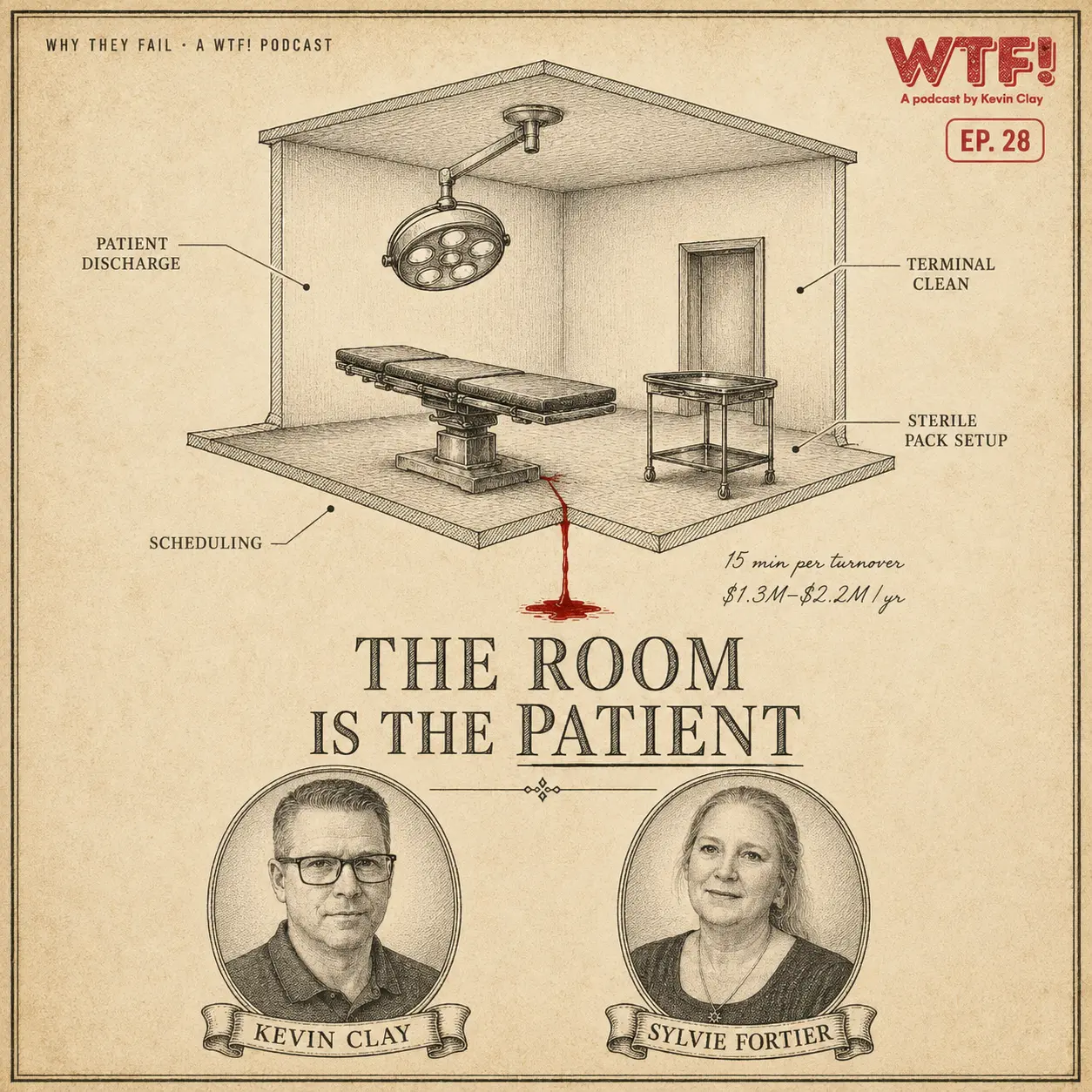
[00:00:00] Speaker A: The unique friction point in an ASC isn't the speed of the surgery itself. It's those uncoordinated minutes that are lost between when the patient is discharged, that whole environmental cleaning that has to happen, the next sterile pack setup and so forth. That's a big deal. And there's a lot of loss there. And it's a huge opportunity. The ASC industry data baselines operating rooms time should be conservatively somewhere between 36 and $60 per minute. That 15 minute lag quietly translates to a financial bleed every single day of 55 to $9,000.
[00:00:41] Speaker B: Welcome to why they Fail, the podcast that pulls back the curtain on why continuous improvement efforts fail. Buckle up because we're not here for motivational fluff. We're dissecting the short sighted decisions and leadership agendas that sabotage CI success. But don't story we'll clue you in to the few simple keys to success to avoid these pitfalls. If you're ready for the truth, let's do this.
[00:01:14] Speaker C: Welcome to why they Fail.
Ambulatory surgery centers operate under intense pressure where top tier surgeons work with precision but uncoordinated minutes between cases quietly bleeding millions from the bottom line. Today we dive into how outside continuous improvement principles eliminate operational friction and safeguard margins in the surgical suite. Our guest today is Sylvie Fortier, an experienced operations leader who began her career at Motorola during the foundational rollout of Six Sigma across a global enterprise. She brings decades of outside systems discipline to high stakes environments, helping leadership teams move from daily firefighting to unified operational sovereignty.
[00:01:59] Speaker D: Sylvie, you were at Motorola during the heyday of Six Sigma when executive leadership trained everyone from engineering down to administrative tasks. What did that level of true corporate commitment teach you about driving a real culture shift? And how did it shape your lifelong view as an operations leader?
[00:02:19] Speaker A: Yeah, starting my career at Motorola during the rollout of Six Sigma was very exciting. It was exciting at the time, but I didn't realize how exciting until I had some additional experience to reflect upon.
I think what struck me most about that time is the scale of that goal felt so massive and the level of corporate commitment was unlike anything I've ever seen since. So you're right, everyone was trained.
But more importantly, I think what really made the difference was that the objectives were completely standardized across the board. Everybody had the same objectives, everyone was on the same page.
And during those times, we're talking about roughly 100,000 employees globally. Yeah. So that experience taught me a fundamental truth about corporate commitment and that it's about standardization. Motorola's continuous Improvement wasn't localized to a particular initiative. It wasn't a checkbox, it wasn't something that was delegated to some random engineering team.
It was truly a universal operating language that the entire enterprise spoke equally amongst leadership and also every particular facet, whether you're in marketing or the factory floor. Everybody had the same vocabulary. That was truly crucial. What that environment really instilled in me is this sustainable culture of excellence. It's not a top down mandate type of a thing. It has to be lived.
That that shared culture has to be lived from the top down. Executive leadership has to actively participate and they can't just delegate.
[00:03:57] Speaker D: You're talking about building a culture from the bottom up and the top down where your leaders have to take part in sharing that culture and they have their own responsibilities. I go into places on a weekly basis that just want people trained. They want to train number of green belts to go out and save the world. But there really is no structure put in place on this podcast like say that the one metric to me that is the signifier of whether an implementation will work is the buy in of the top level. If they just want to train a bunch of people to go and tackle arbitrary problems, as long as it doesn't impede upon their agenda, then that's their idea of continuous improvement.
But Motorola had a completely different way of looking at. They first standardized it so that everybody had certain requirements to get trained at certain levels. Those levels were very defined. Everybody in the organization had to be trained at one level or another. I've talked to a lot of people from Motorola and they said that it was really just part of our DNA. It was in every form, in every system that we existed in. It was this language. It became automatic.
[00:05:10] Speaker A: Yeah, I think an organizational culture is sort of a natural byproduct of removing the friction. That's what Motorola did. When every single person has the exact same goal. Isolate the waste, find the root cause. The defensive posturing that I see in other places, that kind of vanishes when you all have the same playbook. You stop managing by gut feelings and you're then able to get out of the financial spreadsheets. They're important, of course, but managing data driven reality from a common perspective, I think is really what it's all about. From an operations perspective, whether you're manufacturing microchips or whether you're turning over a surgical suite, the laws of operational flow are the same. I focus on the structural alignment and building the precise decision metrics that the leadership needs to protect their Yields friction.
[00:06:01] Speaker D: You also talked about data and those two words really resonate to me. Because if you don't have a good structure and a good culture built of continuous improvement, then you're just going to invite friction in. So if you don't build a structure, it's like building a house. If you don't have a good foundation, the house is not going to stand. If you build a continuous improvement endeavor just by training some people and then tasking those people to be the cops of the company and then go out and change their processes, not work with them to change the processes, you're going to invite a lot of friction in. I say the simple key to success when it comes to building a continuous improvement is you. You have to have metrics, you have to have KPIs, otherwise everybody is going to be or will improve what they think is important. But if we don't understand the corporations KPIs all the way down to the human level, then everybody is going to be improving what they think is going to make the company better. But that may not resonate all the way up.
[00:07:02] Speaker A: Individually they might be really good goals, but if they're not structured at a universal level, you get some challenges there.
[00:07:09] Speaker D: Yes, absolutely. You talked about things like the ambulatory surgery. When we had our discussion before this, you described ambulatory surgery centers as the ultimate operational pressure cooker where high skilled surgeons function like precision machinery and humans are the inventory. What are the unique operational friction points in these environments and where is the biggest opportunity for margin protection.
[00:07:36] Speaker A: Ambulatory surgery centers, ASCs is what I'll refer to them as. Right. The clinical precision is non negotiable, but the rest of the operations are incredibly complex. Like many places. But the unique friction point in an ASC isn't the speed of the surgery itself. It's those uncoordinated minutes that are lost between when the patient is discharged, that whole environmental cleaning that has to happen, the next sterile pack setup and so forth. That's a big deal. And there's a lot of loss there. And it's a huge opportunity that's just sort of standard part of the day in a lot of places. But when you map out that across the standard 10 case daily slate, that minor delay is now 150 minutes of unused surgical capacity. The financial loss of that volatility is staggering. The ASC industry data baselines operating rooms time should be conservatively somewhere between 36 and $60 per minute, depending on complexity and procedure and location and so forth. That 15 minute lag quietly translates to a financial bleed every single day of 55 to $9,000. So that's relentless. It happens every single day. Every day the facility opens, we start again with more bleed. Those are big numbers. Over a year, if you do that out, it's 1.3 to $2.2 million. That's directly from the bottom line. And the investor yields. It's not the medical staff that they're working too slowly. It's purely about the infrastructure itself that has some sort of architectural defect. The it is really caused by information asymmetry between the scheduling folks, the anesthesia, materials, management, all of that. And that's where the biggest opportunity for protecting the margin sits.
[00:09:32] Speaker D: I kind of correlate this to. I get the excuse a lot of times when we teach a class that Six Sigma or Lean or continuous improvement methodologies are only for manufacturing.
They don't care if you're a manufacturer or if you're. You're moving a body through a system. They just care about the waste and the variation that happens in every single process. I don't care what it is in manufacturing to have something called smet. Single minute exchange of dies where we stop making one part and then we retool to make another part. I correlate that to this process. You're talking about the asc, you're just changing over from one operation to another. I bet those aren't always 15 minute changeovers. Sometimes they may be a lot longer. There may be a lot of bare variation, which you can look at this and say, why is there so much variation in the same change over every time? Differences in nurses, differences in their way, their process runs. I talked to a lot of people that are in health care that deal with the same thing, but say the Veterans Administration when it comes to or changeover, or when these private hospitals like Mercy Systems, the same problem, it's right out in front of you and it's a huge win. Every minute that you change or every minute that you recover in that changeover, and every changeover that you make that it's consistently like the next changeover, you gain efficiency in your ASC process, you gain money.
[00:11:00] Speaker A: Absolutely. You're exactly right, Kevin. It's definitely that changeover where the biggest margin is available. Really, it's about stabilizing the friction, standardizing the excellence that they do and, and treating that turnaround sequence as a repeatable high efficiency pathway that protects their yield.
[00:11:16] Speaker D: You can't necessarily just come in and to fix that, you have to start out with a structure. You've got to start off with our KPIs. What is the upper spec limit of what we'll allow? Take data to understand the variation happening between one change over another. Although they're the same exact changeover, but they have widely different times. Unless you have that data management structure, unless you have those KPIs, unless you have this infrastructure structure, this foundation, you're just going to go in and react to problems. When you have nine surgeries in a day when you should have 11, and then somebody starts screaming. In the hospital projects that I've been in, they're kind of in correlation to law firms. I kind of correlate doctors to lawyers, a very cognitive process.
We say we're not here to make the lawyers of the doctors more efficient. We're here to make everything that surrounds them efficient.
[00:12:13] Speaker A: Yes, exactly. Yes. We're not going to walk in and tell the surgeon how to do his job. It's around all of the things that allow that team to go in and do their job and get that surgery done. Well, that's all in the background. It's supporting cast.
[00:12:27] Speaker D: In your work, you emphasize that sustainability completely hinges on the leadership alignment, right? Especially when balancing private equity playbooks with the clinical outcomes. So how do you use tools like Hosting Cannery or the X matrix to get a disparate leadership groups onto the same exact page?
[00:12:49] Speaker A: The leadership alignment thing, I feel, is fundamental. In my experience, most operational problems are not process problems, they're alignment problems. And typically this is human alignment, leadership alignment. Whether you've got multiple factory facilities, one in Kansas and one in Turkey or whatever, if they're operating differently, you've got issues there. It's the same kind of thing. It's alignment. I find when initiatives stall, no matter where they are, they're rarely breaking down because people lack information or standard operating procedures that the SOPs usually exist. The flow breaks down because the stakeholders are operating from completely different, oftentimes unexamined assumptions about what matters most. These tools, whether it's Hoshin Kanri or something else, I happen to like it because it's one page. I find it very elegant. The tools help you distill that into a visual item that everyone has agreed upon and can look to again and again. It keeps everyone on track. It's their beacon. So in the ASC space, the friction is structural. You have administrative and investment partners analyzing the facilities through financial metrics, which is appropriate. And the clinical founders are analyzing this on case complexity, block time, patient outcomes, which is also entirely appropriate. But they simply don't speak the same language. Those are completely two different lenses. To resolve this, I have developed a modular three phase framework that is designed to move the facilities from infrastructure volatility to operational sovereignty. The first part of that is typically a one day kind of event where first there's some anonymous one on one interviews to kind of figure out where the friction is going to be when you get these people together and be able to de escalate some of that. Essentially what happens is people get together in a room and at the end of the day they're left with a Hoshin Connery X Matrix. It's a one page, really their holy grail of what they said they wanted to do. From my perspective, my philosophy is very simple. If your strategy is can't exist on a single page, it's not going to execute. People are busy, they've got other things going on. The X matrix acts as this really ultimate decision filter for the leadership team. It visually connects what are the major objectives, what are the strategic goals. It connects them to their tactical projects that are going to support those goals. And then it explicitly ties specifically what resource is responsible for what. I find it super elegant. I really like it keeps everyone focused on the mission.
[00:15:32] Speaker D: The hosting Cannery is a phenomenal tool. It's a great tool for strategy and execution. We use that as well. We tend to spend time on what's your mission, what's your vision, what's your strategic goals? Like peeling back an onion at the very top with the mission and vision. Drill that down to your strategic goals and down from there into what are those metrics that we need to hit to meet those goals. What are those numbers? I go into companies and they don't know the metric. They know what the mission and vision are and they kind of know what the strategic goals are. But when you start asking them to put metrics or numbers to it, they give you a blank stare. We found that this new wave of AI has really helped us to understand how to use that big brain to get down to that metric very quickly. Hosing Cannery is a phenomenal tool and I will make sure that I put some reference in the show notes to Hoshin Kanry and what it is so anybody else can use it as well.
[00:16:30] Speaker A: Great. Once they have that, the next phase is going to be execution. If they had all of that set execution, everybody already has a job. That integration piece is something that I can do as an interim integration director to permanently institutionalize the breakthroughs that they had on their on site and one Page new edict can kind of absorb that tactical friction without them adding any corporate overhead or long term headcount or anything like that so that the pieces that make it work are actually implemented. Because if you leave just a piece of paper, it's now pretty wallpaper. After they've got all that and they have it implemented, there's one more phase and phase three is really about strategy. It's about maintaining that long term vision and sustaining their momentum. I do a strategic platform summit. This involves moving leadership out of their tactical everyday firefighting. These are retreats essentially that are facilitated strategic retreats that are completely decoupled from the physical distractions of the clinical space. If you bring the principals into some premium neutral venue, this really allows them to truly focus. It allows their nervous systems a break. These are very busy people, they're very highly stressed. They, these retreats balance the intensive strategic planning piece that expansion planning that they'd like to do for further facilities or new goals or expansion within their facility to new services, whatever that might be. It marries that with some elite executive hospitality. So it gives them the space to protect their equity interests while also facilitating really deep personal strategic recovery.
[00:18:14] Speaker D: I think that's really important to pull them away from their reactive nature and get them in a room where you can bounce the goals off of each other. I'm sure you use tools like nominal group technique where you can make sure everybody gets their say in. You mentioned a powerful concept on our prep call. It's not more data, it's a better filter. How do healthcare and operational leaders get trapped in data overload?
How can they build better filters to extract actual root causes?
[00:18:44] Speaker A: Yeah, and it's not just in healthcare. Personally, I feel like it's sort of my worldview. But we live, as you know, in an era where we're just inundated with data. And the healthcare leaders are as well. They have infinite dashboards that's spitting out complex metrics 24 hours a day. But the trap of that is mistaking all of this volume of data for operational control.
They're not the same thing. When turnaround times are lagging or their revenue flattens, there's oftentimes this immediate reactiveness to go look for more data, to track more variables or maybe buy a new software tool. But adding these inputs to a system that's already overwhelmed isn't creating clarity. It just causes further distraction and oftentimes decision paralysis. Execution rarely breaks down because leaders are lacking information.
It breaks down because they lack the ability to separate the signal from the noise. From an engineering brain's mind viewpoint, that's really what it's about. The visible pain in a surgery center is almost never the root cause. It's usually something else if you find the root cause. Typically when you're looking at a particular problem, the root cause is upstream somewhere.
[00:20:01] Speaker D: I do a lot of work with private hospitals and even local rural hospitals. They have these database tools that collect all kinds of data, but nobody really seems to use that data. It's all experiential actions. Nurses that have been there for 20 or 30 years, doctors that have been in their discipline for a long time, and everybody has their own way of doing things. There is no one standard way. I see this huge pot of gold in this data. Nobody knows how to use tools like Lean and Six Sigma to look at this data and see where the trends are using statistics. Because we all took stats in college and were freaked out. I have these people in my class and start to show them how you can dig down in in this multivariate data set. And I did that with the va and they went from root causes and the root causes were always people. And I said 99.99% of the time it's not the people, it's the process. We've got to find the signal in the process. And you can't do that just sitting around and talking to each other. You need to really dig deep into the data. And when they did that and they found these key signals, it was just a phenomenal transformation. I see hospitals, there's such a grassroots effort that can be made to really understand where things are coming from. Hopefully these AI tools, which kind of makes data a little more accessible.
That starts to happen.
[00:21:29] Speaker A: Yeah, a couple points. You're right. They have a lot of data. They're just not analyzing it correctly or in some cases at all. But additional data, typically more data, isn't going to reveal the constraint. You're just going to get buried under a mountain of spreadsheets. Another point you made for I bring decades, more than I want to say of outside operational discipline to an industry here. ASCs historically been managed by financial spreadsheets and clinical habits rather than a lean system. But an objective outsider lens is exactly oftentimes how we identify the hidden friction points and are able to then integrate those bottlenecks that insiders really just don't see. Because as you said, they've been doing it this way for many, many years. It works for them. And they aren't able to see different way necessarily in the same way that Somebody from the outside can. So that's, I think it's an important point that that outside perspective is really valuable, sometimes extremely valuable because systems are universal. The real leverage is building that decision filter, figuring out what you're going to focus on, making sure that you're getting that precise filter to the executive suite.
[00:22:43] Speaker D: Sometimes it takes looking at a process with new glasses, with a different lens. That's excellent epiphany.
Beyond healthcare operations, you are applying this exact approach, operational framework to food systems. In your upcoming book, can you give our audience a quick preview of the Clean food protocol and how applying continuous improvement principles lead to better food and less asphalt?
[00:23:09] Speaker A: Yes, sure. This was the genesis was really a super common. I think all of your listeners will relate to this very common, very frustrating experience that many of us have. You know, at some point, most of us have stood in some kind of grocery aisle looking at some massive wall of yogurt or whatever, trying to make a basic decision and finding that unexpectedly challenging. You see two nearly identical items. One carries this premium price tag, the other one looks exactly the same but cost half as much. So you're wondering, well, am I paying for a real difference here or just a prettier package? That question is super straightforward, but the answers rarely are. We live in this crazy world with all this information.
There's labels, there's certifications, there's aggressive marketing campaigns. All of this feeds into your experience in the grocery store. And all of those things are competing for your attention simultaneously. What starts is the desire to make a simple decision. It turns out to really be this exhausting part time job. And so for myself, as I waded through all of this, I thought back to the core tenet of my Motorola days, when I learned that when the system's overwhelmed with data, the answer is almost never more information, it's always a better filter. Going back to that, I looked at endless articles with opposing opinions and all sorts of confusing different data points. On personal health, I ended up just stopping looking for additional rules to follow and started to look at, okay, where's the filtration points? That makes sense. Where can I separate the signal from the noise as it were? I began mapping out the different patterns. For instance, how biology can help a particular product, fruits, vegetables, that sort of thing. And also looking at regulatory constraints and policies from different countries besides the US by finding those few things that really move the lever and ignoring all the rest, you can really enjoy great improvements. Together, all of those decision filters created the book that I'm calling the Clean Food Protocol. It's very practical. It's like a field guide to simplify a decision making process in the grocery store for people who aren't interested in making nutrition a second career. They just want to get good food for themselves and their families and they don't want to have the hassle involved in it. And they can also save a little money. You can get better food, more value, less hassle.
[00:25:43] Speaker D: Can you. Can you give us just a tidbit of something that we can take away, like when we're looking for a food in a grocery store?
[00:25:52] Speaker A: I can. And also I have for listeners who are interested, I have a free pocket field guide with just a few examples.
[00:26:01] Speaker D: Okay. I'll put a link in the show notes to that. Perfect.
[00:26:05] Speaker A: Sure. An example might be avocados. Avocados are popular food. People like them. Oftentimes you'll see the regular avocados next to organic avocados. Certainly there's a push. Organic is better from an avocado perspective. It's highly shielded, you're not eating the skin. So conventional avocados are very clean. There's not a lot of pesticide residue that gets involved in them. If the price differential between a regular avocado and an organic avocado is very minimal, maybe it doesn't make a difference. But if it's half again as much, then you're perfectly fine going with the conventional avocado and you can kind of rest easy knowing you're not going to be introducing all sorts of crazy chemicals to your family.
[00:26:47] Speaker C: Thank you for tuning in to this episode. We uncovered how operational friction in surgery centers, specifically those uncoordinated turnaround minutes between patient discharge and room setup, can silently cost a facility over $2 million annually.
Sustainable Performance does not come from drowning in more data. It comes from executive alignment using visual frameworks like Hoshin Kanri and establishing a single shared operational language. If you want to dive deeper into building unbreakable systems and eliminating organizational friction, be sure to grab a free PDF copy of my book why they Fail and the Simple Key to Success via the link in the show notes below.
Please subscribe to our YouTube channel as it is a completely free way to support what we do. Make sure you are following the podcast on both Spotify and Apple so you get every new episode instantly and leave us a five star review.