Episode Transcript
[00:00:00] Speaker A: The biggest barrier is that many leaders sponsor improvement but they do not lead it. They approve the program, they attend the kickoff, they ask for savings, they want the dashboard, but they do not change their own routines. Sustainable improvements requires leadership behavior. Leaders need to go to the Gemba, ask better questions, review the right KPIs, remove blockers, protect time for improvements, and reward problem solving instead of firefighting. If leaders only want results but do not change the management system, then the continuous improvement becomes theater.
[00:00:54] Speaker B: Subscribe to our YouTube channel and as it is a completely free way to support what we do and stay connected with our latest visual content.
Make sure you are following the podcasts on both Spotify and Apple so you get every single new episode delivered instantly to your feed. If you enjoyed today's discussion, please leave us a five star review as it helps other Continuous Improvement leaders and professionals find our show. Thank you for listening and we will see you on the next episode.
[00:01:26] Speaker C: Welcome to why they Fail, the podcast that pulls back the curtain on why continuous Improvement efforts fail. Buckle up because we're not here for motivational fluff. We're dissecting the short sighted decisions and leadership agendas that sabotage CI success.
But don't worry, we'll clue you in to the few simple keys to success to avoid these pitfalls. If you're ready for the truth, let's do this.
[00:01:59] Speaker B: Welcome back to why they Fail. I am your host Kevin Clay, Master Black Belt and Founder of Six Sigma Development Solutions. In this episode we are diving into why 96% of continuous improvement deployments crash and burn within 18 months and specifically how executive lip service completely sabotages real operational progress.
Joining me today is Andre Ferreira. Andre is a Mechanical Engineer, continuous improvement practitioner and the founder of Apheria, Germany's first IlSSI accredited Continuous Improvement consulting partner.
Andrei started his career directly on the shop floor where his drive for process precision led him straight into continuous improvement. Today he helps organizations eliminate waste, build operational trust, and turn boardroom talk into real frontline action. You can check out his full background and profile in the show notes below. Let us jump into the conversation.
[00:03:03] Speaker D: Andre, what was the catalyst that got you into continuous improvement? What started your journey? Tell all of our listeners.
[00:03:11] Speaker A: Hello everyone. What takes me to continuous improvement was the fact that I really start directly to work after my studies in the directly in the shop floor. So it was mainly because of that, because of I start to see the things, the problems with communication in the process.
A lot of waste and it was a bit frustrating.
From me as a mechanical engineer, I like to to that the things is a bit perfect, a bit kind of perfectionist. And that leads me to continuous improvement. I know that things were wrong and they could be better. So that's why I, I, I, I then I fell in love with continuous improvement is something like I invest a lot of time and energy and effort to learn and to implement things in the companies where I've been working with. So let's start from the shop floor.
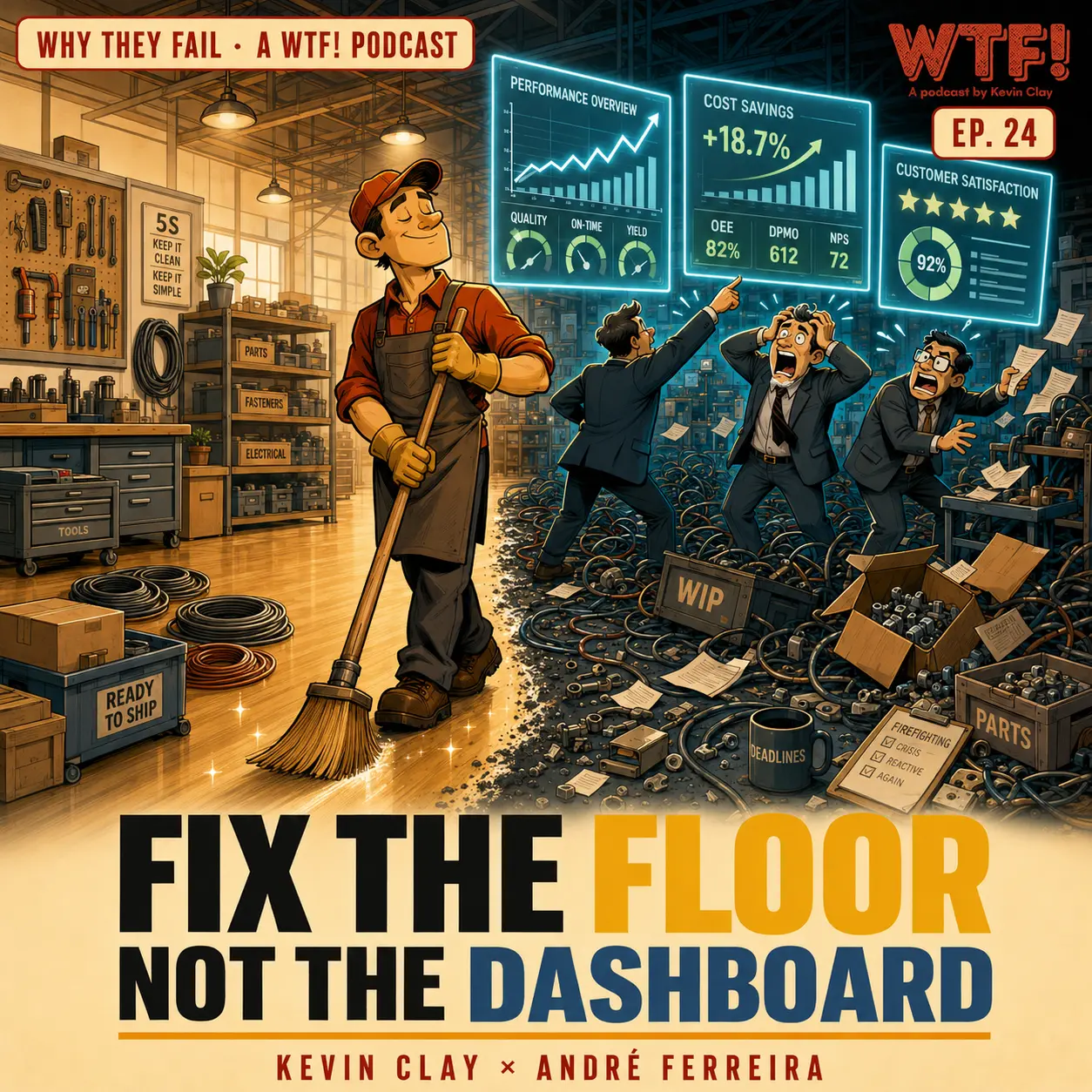
[00:04:10] Speaker D: Okay, Excellent. In my book, I talk about how 96% of continuous improvement deployments crash and burn within 18 months. When you're dealing with a really messy operation, why is it so critical to clean the house using a basic quote lean broom before trying to sanitize it with more advanced data and math?
[00:04:33] Speaker A: When an operation is messy, advanced data can become dangerous because it gives precision to a system that is not yet stable. Before we talk about statistics, control shards or complex dashboards, we need to understand the reality of the work. Where is the material? Where is the waiting? Where is, where are the people? Searching, walking, reworking, firefighting. That is why basic tools matters as process, observations, spaghetti diagrams, visual management, standard work, simple KPI's words. They look simple, but they expose reality very fast. In my experience, many companies want to jump directly to advanced analysis because it feels professional. But if the process is not visible, stable, and understood that it only makes the cows look smarter.
[00:05:36] Speaker D: Okay, excellent. Excellent. Right? I heard you say KPIs. I'm a big believer in KPIs. I go into a lot of companies and one of the first things I do when we get engaged with a company is ask the people on the floor, what are your KPIs, what are your targets? What, what are you working towards? What's the end goal? And I usually get the answer. That's a blank stare. They look at me like I don't know what you're talking about. Go talk to my supervisor. That's something that I see missing in a lot of companies. I also see that I have to argue with you a little bit in the fact that I think complex analysis is not needed in the beginning. Definitely when you use that lean broom and use those lean tools to stabilize the process. Right. But you do have to have knowledge of data and data points and start collecting data. I like to call Six Sigma, the stealth Six Sigma. It comes in, comes in behind lean, and not a lot of people see it. But that stealth Six Sigma is collecting those data points because eventually we're going to need that. You can't manage what you can't measure. I Think you're right is in lean as a forefront because it's capturing those quick wins. It's that basic lean room cleaning things up. But you're never going to get to a sanitized floor unless you really dive into it. But if you don't have data, all of a sudden, you're going to get from this lean implementation to no data and not being able to then optimize your processes. You mentioned that data must lead us to our problems rather than people sitting around in a boardroom pointing fingers. Why are Objectives Non fuzzy KPIs the ultimate filter for separating true business constraints from an executive's personal agenda.
[00:07:21] Speaker A: Without objective KPIs, every leader brings their own opinion into the room. Production says the problem is planning. Planning says the problem is capacity. Quality says the problem is process discipline.
Finance says the problem is cost. Sales says the problem is delivery. And sometimes everyone is partly right. The role of KPIs is not to create more reporting. The role of KPIs is to create clarity.
A good KPI system shows where the business is really bleeding.
Downtimes scrap, late delivery, rocket cash, poor OE, unstable lead time, weak first pass held. The important point is that KPIs must trigger decisions. If a KPI does not change a conversation, a priority or an action, it's probably just the decoration.
[00:08:23] Speaker D: Okay, yeah, excellent KPIs. I like to look at KPIs as my guidepost. It tells me where to go, it tells me what's next. It tells me what project we need to take on, where we need to focus. It amazes me. Companies that don't use KPIs to understand where to go next. They just sit in the boardroom and say, okay, where are our problems? Let's go fix them. In most cases, this leads to even more chaos. But if you have well defined KPIs at the organizational level, all the way down to the operator level, then everybody knows how their actions affect success. I talk about in class how you go out and you work all day long, hard, hard, and at the end of the day you sit down and you go, what did I really do today? What did I accomplish today? Because I don't really know. I don't have a scoreboard telling me it's like watching a basketball game without a scoreboard. I mean, it does make sense. A high scoring game and you have no clue what's going on. That's what happens in most companies, that people on the floor really have no clue what's going on. Because those KPIs are invisible. They're not, they're not advertised. And a lot of times those KPIs they want to keep them away from the operators because they have more to do with cost and revenue than operational goals. I'm a big believer in KPIs and having clarity to make the process clear as to where we go next. Leaders often make the plumber mistake by expecting the novice belt to single handedly save the world without infrastructure hiring the the plumber who is a good plumber knows how to plumb but doesn't really understand how to build the actual house. How do you create standard communication loops so operators know their ideas are actually being heard?
[00:10:13] Speaker A: The worst thing leaders can do is ask operation operators for ideas and then let those ideas disappear. That destroys trust very quickly. So the communication loop must be simple and visible. If the operation arise raise a problem. The team needs to know three things. Who owns it? What is the next action? When will we review it? This can be done through daily shop floor meetings, visual boards, idea cards, thinking or simple action trackers. The tool is less important than the discipline. Operators do not not do not need every ideas to be accepted but they need to see that the input is taken seriously even if the answer is no. Explain why that builds credibility. Atafaria this is something I strong believe in improvement. Culture is built when people see that speaking up leads to action.
[00:11:20] Speaker D: Okay, I've seen in the past where problems happen and people keep it quiet, they sweep it under the rug because the action that comes from from making a mistake if somebody gets in trouble, which is completely ludicrous to me because all of a sudden that's a process that's screaming at you that hey, I need to be fixed. But our leaders are in an ivory tower and our operators are on the floor with their hands dirty and but the operators don't voice those problems because there is always a bad result from it that really doesn't make a lot of sense. I go into some companies that have a very good feedback loop. They have operators on the floor that have access to a project hopper or a suggestion box. A lot of them through digital means, their iPhone or Android and they say okay, I'm over in the brake department and having to walk 30 yards to go get something 15 times a day. I think that's a waste. I think we're wasting money. They put it into the system, it goes into portal where it gets prioritized by a group of people and then if it's something that needs to be fixed, it Has a direct impact on the KPIs, whatever we're talking about. We then advertise that as the next priority of a project.
So think about that, how effective that is. Where I as an operator out on the floor, see something. I then put it into a system to where it gets prioritized, Then it gets put up into a list of priorities. Maybe I'm the third project to be taken on and then I'm invited to be a part of that project. After I finish that project, they advertise it as to what was the effect.
So that creates a whole loop that loops created. I'm gonna recognize any projects. If I see something wrong, I'm gonna write it down and put it in that system. But what I see is most companies, when that person identifies a project and tells somebody and it doesn't become a actual project, nobody goes out and communicates to them. So if I do that, nobody communicates to me. I'm gonna come back and say, nobody cares that feedback is so important.
Breakthroughs require deep cultural trust. Yet operators who have worked the same way for 20 years are really terrified that process metrics mean that they'll be replaced. So how do you break down that resistance and build a culture that's safer for those employees?
[00:13:59] Speaker A: Resistance is usually not the real problem. Resistance is information.
When operators register, they are often telling us something important. They do not trust the intention, they do not see the benefit, or they have seen previous improvement projects used against people. So the first step is not to push harder. The first step is to listen better. You have to make clear that the process metrics are not there to blame people. They are there to expose the system. Waiting rework, unclear standards, bad handoffs, missing tools, poor planning.
These are usually systems problems, not people problems. I like to say we are not measuring people to punish them. We are measuring the process to make their work easier and the business stronger. And then you have to prove it through action. Remove friction, fix small problems, show that that leads to support, not punishment.
[00:15:06] Speaker D: Yes, if you go in and implement any continuous improvement and Andre, I'm sure you've seen this and you come into a company that they want problem solved, but their people on the floor aren't really educated about the problem solving methodology like Lean or Six Sigma. And then they're invited into a process investigation where we're trying to improve the process and, and they know nothing about these methodologies. The first thing that's going to happen is they're going to be defensive. They're going to think, well, what did I do wrong, am I going to improve myself out of a process? And I see that all the time. When we don't educate our people on the floor, they're the first people that should actually be educated in any endeavor when it comes to continuous improvement. Because they are the ones with the knowledge that's really part of our deployment, the way that we deploy. One of the first things we do is it's something called a white belt training so that everybody understands what's coming down the pipe and they start to understand that we're not here to get rid of people. We're here to improve processes, increase capacity, and you need more people. Once they find that out, the fear goes away. And then they're really contributing part of our process improvement success.
[00:16:23] Speaker A: For me, it's like in continuous improvement, like when actually everyone is involved in the idea of the business and everyone can see this win, win solution for everyone.
Like I said before, that someone will be blamed or punishment, that we work as a team. So success comes from that. When everyone else can succeed, we can succeed as well. So it's like win, win situation from everyone. And with that, with continuous improvement, I am really pushing and for people to continue also learning is also really important. That is something that we cannot stop to learn. Because learn this learning process will also give us things and bring us to the success.
So it's. It's a combination of several points. It's like success can start to with ourselves, but then it depends on others also.
[00:17:30] Speaker D: Okay, excellent. I preach that the belt's role is to act as a facilitator and a mentor rather than a problem solver, which is. That's almost a hidden fact sometimes in what we do that the green belt or the black belt or the consultant is not there to fix the problem. They're there to work, act as the guide on the side to help lead the problem towards the solution. But you can't solve a problem without the SMEs. As you expand your global consulting firm, what is the single biggest barrier that you see keeping leadership trapped in executive lip service instead of building a more sustainable foundation. What do you think the biggest barrier is to that?
[00:18:17] Speaker A: The biggest barrier is that many leaders sponsor improvement, but they do not lead it. They approve the program, they attend the kickoff, they ask for savings, they want the dashboard, but they do not change their own routines. Sustainable improvements requires leadership behavior. Leaders need to go to the Gemba, ask better questions, review the right KPIs, remove blockers, protect time for improvement, and reward problem solving instead of firefighting. If leaders only want results but do not change the management system, then the continuous improvement becomes theater. People see it very quickly.
[00:19:06] Speaker B: Thank you so much for tuning in to today's episode of why they Fail. A major thank you to Andre Ferreira for sharing his sharp insights on what it really takes to stabilize a process before jumping into complex data. To recap today's key takeaways. First, advanced data in an unstable process only makes the chaos look smarter. You must use a basic lean broom to clean the house before trying to sanitize it with advanced statistics. Second, KPIs are not decorative reporting tools. They are clarity tools designed to filter out personal agendas and trigger real operational decisions. Third, when operators give you resistance or sweep mistakes under the rug, it is not a people problem.
It is a system problem caused by a lack of trust and bad feedback loops. Real cultural change happens when executive leadership moves past lip service, gets to the Gemba, and changes their own daily behaviors. If you want to dive deeper into why so many transformation programs stumble and how to fix them, grab a free PDF copy of my book why they Fail and the Simple Key to Success using the link in the show notes below.