Episode Transcript
[00:00:00] Speaker A: The problem is, I think it feeds back into a negative loop with the nurses and the frontline staff to say, okay, on this subject. They're telling us, don't think, just do what I tell you to do. Which in turn actually perpetuates change aversion. And it perpetuates the lack of buy in when you're searching for volunteers to help with the process improvement project.
Because the nurses, they're saying, well, on this one hand you guys told us, don't even question your decisions, you're going to do this. But then on the other hand, you're telling us to be empowered to make our own decisions and change. And so it's a contradictory message.
[00:00:42] Speaker B: Welcome to why they Fail, the podcast that pulls back the curtain on why continuous improvement efforts fail. Buckle up because we're not here for motivational fluff.
[00:00:54] Speaker A: We're dissecting the short sighted decisions and
[00:00:57] Speaker B: leadership agendas that sabotage CI success.
[00:01:00] Speaker A: But don't worry, we'll clue you in
[00:01:03] Speaker B: to the few simple keys to success to avoid these pitfalls. If you're ready for the truth, let's do this.
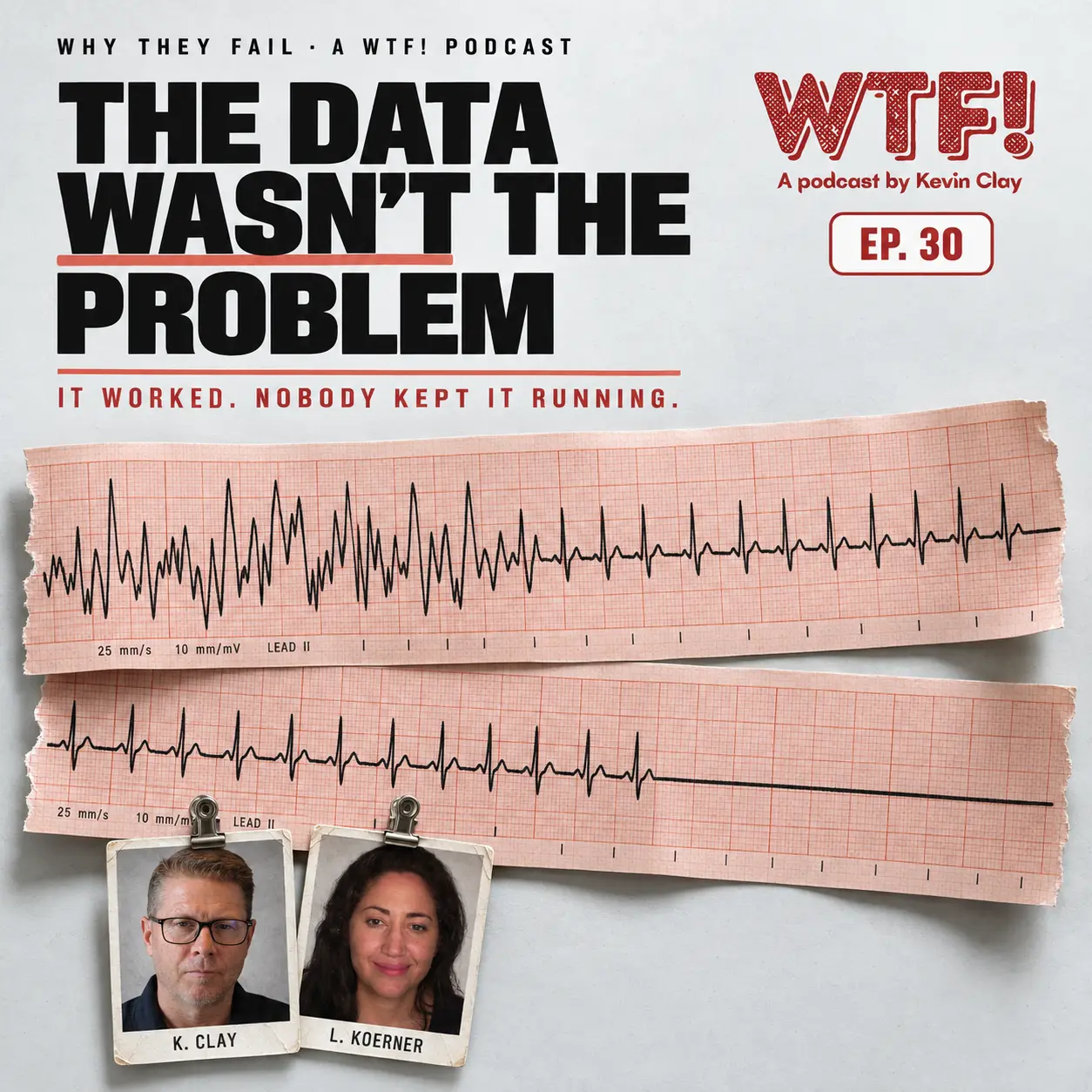
[00:01:15] Speaker C: Welcome back to why they Fail. Today we are joined by Lacey Kerner, a Master of Science in nursing, registered nurse and certified emergency nurse who spent over 16 years in healthcare, including 13 years at the bedside, over a decade in the emergency department, three years in hospice, and extensive time leading quality management and quality assurance. When Laci and her team took on a lean Six Sigma project inside a Veterans affairs emergency room, they tackled the erratic door to dock variation, cutting down wait times and proving the data could deliver real results.
But even after a statistically significant win, the project hit a systemic wall. Lacy joins us to share the candid reality of navigating government health care bureaucracy. The contradictory push and pull between top down mandates and frontline empowerment. And what really happens when an improvement works on paper but has no lasting culture to keep it alive.
[00:02:18] Speaker B: Lacey, what was your catalyst? What got you into continuous improvement as a nurse? What led you in this journey?
[00:02:26] Speaker A: Thanks for asking. Thanks for having me on, Kevin. I have been a nurse for 16 years. I worked 13 years bedside over 10 in the ER, three in hospice when the very infamous case. I wonder if your healthcare listeners will be familiar with this case. It's the Radon Devott case.
Happened back in 2017. This is a nurse at Vanderbilt University who gave a fatal dose of a incorrect medication and ended up killing the patient who was in the MRI machine. I listened to a podcast a couple years later about the event. Criminal charges had already Been she'd already been through her trial listening to this podcast. It was by a doctor and they were talking about medical errors, medical mistakes and patient safety. That podcast is actually what kind of sparked my passion for process improvement, patient safety, making sure that we're actually using evidence based practice. And I will say that I think it's always been a passion, but it took me listening to that particular information about patient safety and medication errors and these types of things and how can we fix it? Where can we go from here? How can we make this better? How can we decrease med errors? It was very clear to me that this is my passion as far as process improvement goes in numbers, statistics, math. I've always loved those things. And I've actually kept up on my understanding of statistical analysis and research and hierarchy even while I was working critical care, ER and hospice. It's always been a passion of mine, numbers and statistics. So it kind of fits me. That's how I got here.
[00:04:06] Speaker B: You were in a class that we threw at the VA in Denver where you took on a project and a number of your colleagues, and it was a great class and there was a lot of good things that came out of that. I want to kind of focus our chat today around that whole environment of continuous improvement in a class where people were kind of thrown together to improve some processes. In a government system as massive as the va, we do a lot of work with different hospitals, private and public, and the VA as well. Does the culture actually embrace the data? There's a lot of data that was brought by each of the teams, and for some of you, it was kind of hard getting that data. There's a lot of obstacles to capture that data. Does the culture actually embrace the data or is continuous improvement really just seen as extra homework for the staff?
[00:04:59] Speaker A: I would say that yes. I think in healthcare in general, just across the healthcare spectrum, clinicians are now more savvy. They kind of understand that data is the new way. And if you want to make a change, you really need to have the data to be able to provide the evidence to support the change that you want to make. I think we're going in the right direction with that.
Now as far as data goes, the government, especially the va, has a ton of data. What do we do with all of it? Do we even use all of it? How do we use it? How do we make sure we're using it correctly? Those are questions that are not as clear to clinicians. One of the things that I've noticed in our system, in this government System, so massive bureaucratic system.
And when you look at it from a systems thinking perspective, which is more of a global view of what's happening within whatever your organization is, when you look at it from a systems view, when we look at the structure of a bureaucracy, the massive structure really is going to determine how the system behaves. And this massive system that is the va, no one person truly understands all the ins and outs of what goes on. And that's a product of technological advance, et cetera. There's just a lot of technology and there's a lot of data that we're not grasping all of it together within this structure, the bureaucratic structure.
It's very difficult for clinicians to embrace process improvement that sticks. Not because they don't want to, not because the process improvement wasn't a good idea, not because the project was doomed to fail.
The kicker is we're not able to embrace process improvement because of the massive systemic structure of the government in which we are working.
And so that's a huge piece I
[00:06:55] Speaker B: saw in working with the VA, and not only with Denver VA, but VAs all over, that access to data was like pulling teeth. Getting data was. You had to really unlock many doors.
[00:07:09] Speaker A: Getting the correct data.
[00:07:10] Speaker B: Yes, getting the correct data or even getting access to data. We had clinicians that were trying to that solved problems but couldn't actually get the data to solve those. That impedes a project progression where you're constantly running into roadblocks for data request.
[00:07:29] Speaker A: Absolutely.
[00:07:30] Speaker B: I think you had a number of people that were actually in the class that were in the back end and could get a little bit more access to it. But because of the hierarchy of the va, it was still difficult to get to that. When you started looking at the door to dock variation, did your fellow nurses see you as a peer trying to help them or were they defensive because they didn't really understand the process, the lean six Sigma process?
[00:07:59] Speaker A: They were not welcoming with open arms. Let me just say, when we're talking about emergency department nurses, which I am one, I feel like I have ER nurse blood running through my veins.
The ER is notoriously kind of like wild creatures in a zoo. You gotta keep them behind a closed door, don't get too close. They didn't exactly welcome this project with open arms. They also don't know me as an ER nurse. They know me as more of a quality management nurse, quality assurance nurse. What we did though is we obviously wanted to have all frontline input, and that's a part of the lean process. Totally it's the of part also part of change management. If you don't have those frontline staff members engaged and with buy in and understanding and being aware of why we even need to change, if you don't have that foundational knowledge for them, then it's really going to be rough for sustainment at least I think nurses and clinicians go along with process improvement projects. But when we talk about sustainability, that's where we fall apart with more defensiveness. Even though we really tried to explain that you guys as the front line are going to be making the decisions and deciding on the changes.
[00:09:14] Speaker B: I've interviewed several people that are in different aspects of healthcare and quite a few people from ED and say the same thing. It's a very reactive process.
They're kind of fighting inherent variation every day. And we talked about things like over our changeover and how that process, although it should be exactly the same every time, from nurse to nurse, from shift to shift, from person to person, it's done differently because we all have our own inherent processes that we know instead of.
[00:09:52] Speaker A: Yes.
[00:09:52] Speaker B: That everybody knows. In a very chaotic environment like that, it is very hard to get people to change.
This is really where I talk about my book about how before you can ever make a change in a process like the VA called us to train some green belts. But we went in and found out that there really is no infrastructure, there is no project copper, there is no upper management.
It's just we picked some projects and then we kind of dove into them.
Those things that are detriments of that are that we started getting blockaded by data.
Even though we had these problems, you and your team prevailed. You fought through it and came out the other end, which is awesome. But you had to fight a lot to get there.
[00:10:44] Speaker A: Yeah, we did.
[00:10:45] Speaker B: Had we had that infrastructure, had those nurses really understood what the end goal of Lean Six Sigma was, they were trained, then you would have been able to come into an environment that was already open to you.
[00:10:59] Speaker A: Yeah, exactly.
[00:11:00] Speaker B: Instead of taking on a project that wasn't necessarily forced down their throat, but they've got 9 million other things going on and I don't think they saw the benefit of it. I believe they did at the end when. When the improvement was put in place.
[00:11:15] Speaker A: Yes. And the data speaks to that very well. We did have a statistically significant decrease in our door to Dr. Times and everyone was actually very impressed with that. The ER nurses and the ER physicians.
It still wasn't sustained though, unfortunately.
[00:11:31] Speaker B: It probably went back to the way it was with Change in leadership. That's another thing about the va. Every election cycle things kind of change.
That's again going back to the structure. If you don't have an infrastructure in place, then these things have a tendency of knocking those improvements back out again.
We talk a lot about non fuzzy KPIs, but getting a straight answer in a government setting can really be a nightmare. How much red tape did you have to cut through to just get the data for your analysis?
[00:12:05] Speaker A: It took a lot. Like you said, there's a ton of data, but actually getting access to it and finding the correct data is the hard piece. When we started this project, we gathered what we thought was going to be the correct data and I can't remember all the specifics but. But it was missing certain integral parts that we really needed to be able to do the data analysis and the defining and measuring and analysis stage it took. Now I would say for me it didn't take as long as it may have another employee, only because I was already familiar with some of these data platforms and so I was able to kind of go in and search through and do a little bit of digging.
That being said, I think it still took us about two or three weeks to get the correct data that we then sent to you and you signed off on saying, yes, this is the data that we need to use, we'll be able to monitor our outcomes with. For me, it wasn't as difficult. It was difficult. The level of difficulty for me was lower though than it would have been for another colleague who's not as familiar with pulling that data and data mining in the VA.
[00:13:15] Speaker B: If you're not a 15 year experienced nurse who's seen where the data is, knows kind of where it's hidden, but you're just somebody coming in, maybe it becomes a lot harder to understand because first you have to understand the questions to ask. Yes, really, data, you have to go out and find it.
That's one of the things that we talk about in some of our podcasts is the lean is the reduction of waste. And spending all that time searching for stuff means you're not getting the answer. Putting a structure.
[00:13:48] Speaker A: There can also be data errors that nobody knows because how did this data even get here? Where are you pulling it from? So there's that piece too.
[00:13:57] Speaker B: Did the executives actually act as a bulldozer to clear you path or was there just lip services expressed in wars but not really backed by actions?
[00:14:07] Speaker A: We did have executive leadership sponsorship just to actually get you guys to our VA so that we could Take the course. As far as executive leadership involvement goes, I'm just remembering that that's about as far as that went with our leadership.
Now, I was lucky. Our group was lucky because we were working at the time with the Chief of Emergency medicine who was a phenomenal champion for process improvement. She actually understood the lean process and I think she actually really catapulted us and helped us get to the end. This just for, as an example, she's not a senior leader, but she is in that kind of Bravo Charlie level leadership.
We were meeting with her every week and she was very, like I said, very engaged, really collaborative. We had one week where we had went down. We met with the staff, we did some Gamba walks, we got a little bit more data and she helped us realized that we had scope creep, major scope creep going on. And she just, her background knowledge really helped our team. It really helped our team to get to the finish line because without someone who actually is a leader in the area you're working, if you don't have their total buy in and maybe if they don't understand the lean process, it's just going to be more challenging to get across the finish line.
[00:15:30] Speaker B: That's a good point. If you take on a project to improve a process in the edge and nobody really knows what it is, they don't know what lean and Six Sigma are. You may not have leadership buy in, but you're supposed to go in and make changes and engage people that are knowledgeable in that they're going to give you a pushback. The leaders are going to give you pushback because they've got things they got to do, they've got numbers, they got to hit the nurses. Their job is to take care of people. So if they don't understand what the end goal is, without that structure behind it, it's really hard to finish the project.
There's more friction.
[00:16:06] Speaker A: Correct. When we look at change management methodologies as well, we know it's been proven that without the immediate supervisors buy in of which we did not have, so we didn't actually have the emergency department nursing managers buy in at the time. Without that immediate supervisory buy in and without an executive team leader who can really sponsor the project and be present and let the staff know that this is something that our executive leadership supports, without those, statistically speaking, this process improvement project is destined to fail. That's what the research shows us from a change management approach.
I think two of the most common continuous process improvement initiatives that healthcare uses are evidence based change. If we can get the evidence or we can get the data to show that we want to change.
And unfortunately, the other way that we do continuous process improvement is through top down change, which is, your boss says, we're going to do this, insert this new process to improve this metric. We're starting next week, no questions asked. And I think the problem that we have is vacillating back and forth. I think it's one of the problems, vacillating back and forth between letting the frontline staff own change and letting top down own change, which really you need both, especially in a healthcare setting. But the problem is, I think it feeds back into a negative loop with the nurses and the frontline staff to say, okay, on this subject, they're telling us don't think, just do what I tell you to do. Which in turn actually perpetuates change aversion and it perpetuates the lack of buy in when you're searching for volunteers to help with the process improvement project.
Because the nurses, they're saying, well, on this one hand you guys told us, don't even question your decisions, you're going to do this. But then on the other hand you're telling us to be empowered to make our own decisions and change.
And so it's a contradictory message.
[00:18:13] Speaker B: It's a catch 22 that can be a bad thing or a bad environment to be in, but nurses just, they fight through. I have the biggest respect for what nurses do because they're in the battlegrounds every day.
[00:18:28] Speaker A: I think these top down changes, I think we do those a little bit more off the cuff. They're not as intentional. It's kind of a knee jerk reaction to a bad metric or an unfortunate patient outcome and we just make a choice and change the process. The staff then perceive that as, oh, this is just a flavor of the month.
Give us some time and they'll forget about it. It unfortunately does create a lot of disdain amongst the bedside staff. It is a catch 22.
[00:18:55] Speaker B: Lacey, looking back at the project, did the improvements actually stick or did the process drift to its old state because the foundation was not there to sustain it?
[00:19:06] Speaker A: Unfortunately, process fell off as soon as we stepped away from it.
There is that really important time between when we're in the control phase, when we're handing it off to the subject matter experts and the process owners. We did a handoff and like I said, after that it just fell flat. Like, I call it a DOA pip, right? The PIP is doa. It's dead on arrival.
So unfortunately it was not sustained.
[00:19:37] Speaker B: Lacey, can you tell our listeners what the process was?
We talked a little bit about door to dock and we've talked a little bit about the process. But give us a little more understanding of what it was that you tried to attack. The problem statement, goal statement, or what was it at a high level that you and your team took on?
[00:19:59] Speaker A: We were tasked with originally decreasing our lift without being seen rates. Now anyone who works in the error for any amount of time, you know that left without being seen is when a patient leaves the ER without having been seen by the doctor, got a medical screening exam by an emergency physician. It's a high risk situation. You have a patient that nobody actually ruled out whether there was an emergency situation going on. That's why we were tasked with lowering that number. In traditional emergency medicine, you can left without being seen rates very easily by manipulating the data. You have a patient who shows up to the er, they get. They get registered in our system, and as soon as the registration starts, that's kind of the clock that starts. Once a doctor physically signs up for this particular patient, the gap has closed, basically, and the patient can no longer leave without being seen because now they actually have a doctor who signed up for them.
I've seen emergency departments kind of, I don't want to use fudge, but artificially, you know, decrease their numbers just by changing a couple things. We're going to sign up for patients as soon as we see them on the board. That way our numbers will look better. But really you're not doing anything in reality to make the process more smooth, to get the patients seen sooner or to help with throughput.
We went down and did a Gemba walk. And Gemba walks are what we call the go and see in lean. And we go to the subject matter experts, we go to the environment, and we actually walk through with the subject matter experts how they do this process. What we learned when we were down in the ER was actually really refreshing because our ER docs will only sign up for a patient when they are ready to see the patient, which is ethical and correct, and that's the right way it should be done. If you want to have your numbers reflect accurately. We did not want to alter that process in any way because that's the correct way it should be done.
Instead of looking at how many people left without being seen, we decided to kind of shift our focus to, okay, let's look at this door to dock time. Because they're saying that as soon as they are ready to see a patient, they'll sign up and then they will go see the patient. Within a certain amount of minutes between signing up and seeing the patient. We did witness that jumping ahead just a tiny bit, we did do a measurement system analysis to make sure that our data was actually reliable, which involves, once again, it's a Gemba walk. So you're going to observe how many times emergency physicians sign up for a patient and how long does it take these emergency physicians to actually go see the patient. We needed to verify that that was going to be a reliable, structured time. And what we found was that, yes, we. I can't remember exactly how many of those observations we did enough to where we had a percentage where we felt strongly that monitoring this door to dock time would be reliable and consistent. So that's kind of how we switched over.
Then we encountered some challenges. You know, when we're trying to analyze this data, you have these very sophisticated data analysis software that you really need to learn. There's so many different nuances to it. You could get wrong numbers just by typing in the wrong information.
And so that's actually what happened to us. We had something wrong in our distributive chart and the summary analysis we had. I don't think we had our border at zero minutes. I think it was like an infinite border. Well, when you're dealing with a continuous data set, but it's time. There's zero. There's no negative time. That was one thing that we found that we made an error on and that caused, you know, it's such. It seems like such a tiny, trivial matter, but it skewed our data significantly. When we finally, you know, did that correctly, where we had our border at zero minutes, you know, and then it continued, you know, infinity, we got numbers back that we could rely on, and we found that we had a door to dock time frame that was highly variable across physicians, anywhere from five minutes all the way up to 400.
We had a lot of outliers. So when, you know, when you're looking at a graphical analysis and you pull up those outliers on, like a statistical process control chart, we had a sea of red is what they call it, right? With all those red outliers, that told us that our process for the door to dock, just that process in general was out of control, There wasn't a lot of consistency. There was a lot of variability. When we found that variability, which was. I can't remember the. Can't remember the actual wording for the variability that we used, but that's when we decided that would be our focus. We're not even looking at decreasing a rate or decreasing a number of people who leave or anything like that anymore.
Now we're focused on variability. For us, that was really hard to kind of get our heads wrapped around. We're not trying to improve a metric by a process that includes if we get this number down or this number up or whatever we're looking at, how can we decrease the variability within a process. So just understanding that piece was a was huge.
[00:25:38] Speaker B: You found out that you had the Wild West. There was all kinds of different things going on. Everybody was kind of doing things differently. That's really what most of our students find is they find that when I'm analyzing a process and we've got 20 people doing it 20 different ways because they've all learned their own way to do it, not a standard way, then that's really just the foundation of our process. You look at a control chart and it's funny because you saw that that you see a control chart with red dots which many tab or some of the other stat tools pokio can tell you this is outside of the normal variation. But when half of your variation is outside of the normal variation, it just means that you don't have any control in the process. It's a wild West. We're all doing our own thing.
You determined that's where we need to insert ourselves is how do we put some controls in place? How do we put some processes in place just to fix some of these outliers? I think that's where you found your success.
[00:26:37] Speaker C: Thank you so much for tuning in to this episode of why they Fail.
Today's conversation with Lacy cuts straight to the core of process improvement in high stakes healthcare. Fixing door to dock variation and eliminating outliers is entirely possible with the right data, but as we saw, even great improvements fall flat if frontline clinicians are trapped between top down commands and mixed messages about empowerment. Without executive alignment, supervisory buy in and a sustainable cultural foundation, even statistically proven gains drift back to square one. If you want to dive deeper into why so many well intentioned initiatives collapse and and how to build systems that actually last, be sure to grab a free PDF copy of my book why they Fail and the Simple Key to Success linked directly in the show notes below.
Please subscribe to our YouTube channel as it is a completely free way to support what we do. Make sure you are following the podcast on both Spotify and Apple so you get every new episode instantly and leave us a five star review.