Episode Transcript
[00:00:00] Speaker A: How do you know what's good and what's bad? Because I don't see any numbers in the problem statement is a key to me that this problem is based on emotion, not data. I think a lot of our opportunities are to get the leadership back to the front lines and asking the questions in the gimbal walks. How do you know what good is? How do you know what to do to have a good outcome?
Where is that documentation? And start building that foundation.
[00:00:30] Speaker B: Welcome to why they Fail, the podcast that pulls back the curtain on why continuous improvement efforts fail. Buckle up because we're not here for motivational fluff. We're dissecting the short sighted decisions and leadership agendas that sabotage CI success. But don't worry, we'll clue you in to the few simple keys to success to avoid these pitfalls. If you're ready for the truth, let's do this.
[00:00:59] Speaker A: Foreign.
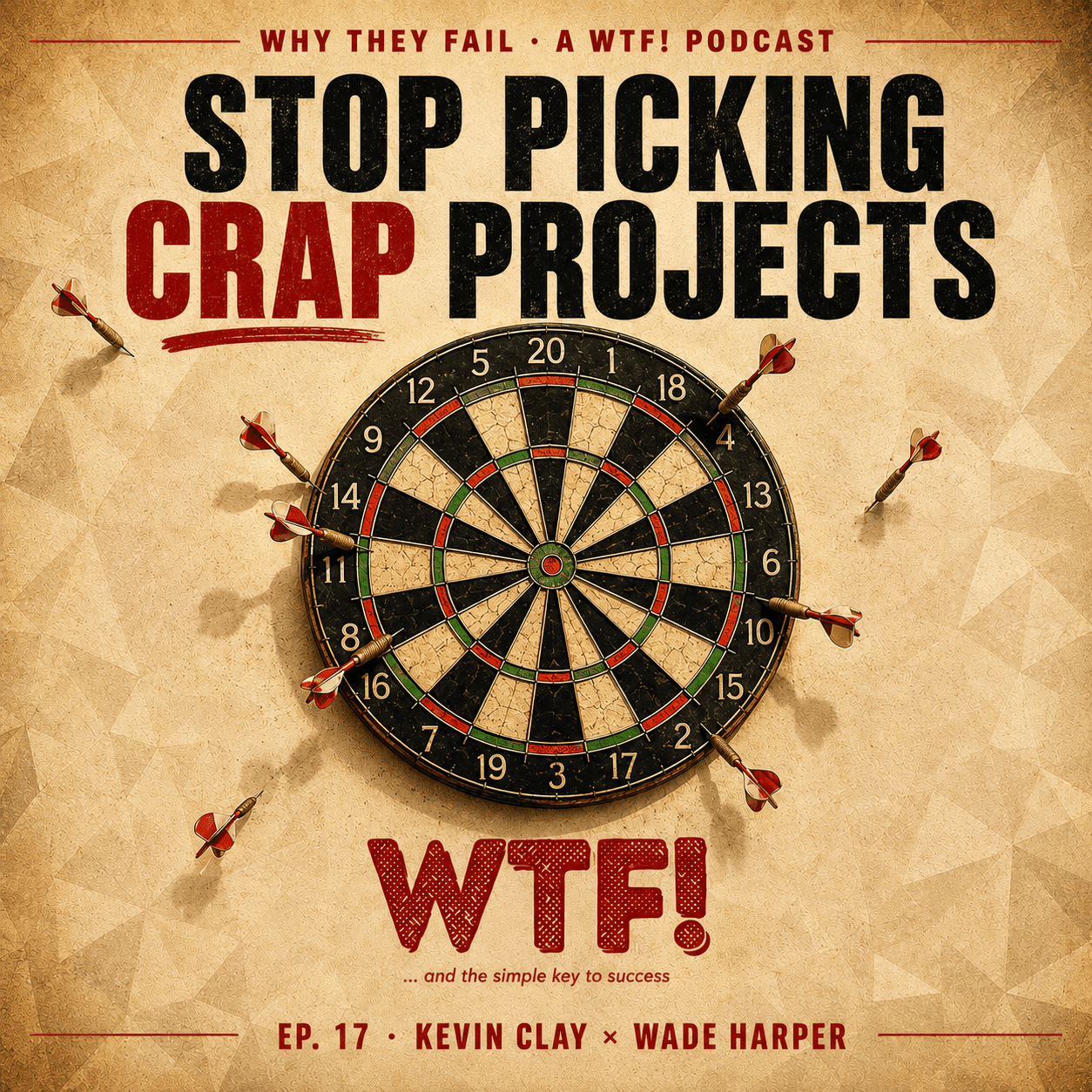
[00:01:06] Speaker C: Leaders Pick Crap Projects welcome to another episode of the why they Fail podcast. I am your host Kevin Clay and today we are tackling a critical breakdown that causes continuous improvement initiatives to crash and burn across the corporate world.
Why leadership teams consistently choose bad projects based on raw emotion instead of hard data.
Joining me today to unpack this systemic failure is an absolute titan in our industry. Wade Harper Wade brings an incredible 40 year continuous improvement career to the table, having started as a mechanical and process engineer working on nuclear weapons at Allied Signal under Michael Harry, one of the original founding fathers of Six Sigma. Wade later moved to Ford Motor Company where he climbed the ranks from black belt to master black belt before heading up design for Lean Six Sigma deployments at Honeywell. He also worked alongside Michael George to deploy Lean Six Sigma throughout the United States army, including a major hiring process overhaul at Fort Huachuca and and went on to lead healthcare and pharmaceutical program deployments for eight years.
For the last eight years, Wade has operated as an independent consultant, helping organizations stop managing people and start managing their processes. In this conversation, we pull back the curtain on executive lip service, vanity training metrics, and the absolute operational chaos that ensues when leadership chooses arbitrary pet projects or over data driven process constraints.
Let us dive into the episode.
[00:02:57] Speaker D: Wade, give us, give us some background on what got you into continuous improvement.
I met you at a Lean Six Sigma Expo in Orlando at Disney World. It's a couple of years ago. I was really impressed by you, you and your wife and we had a lot of great conversations and it's taken a long time, but I'm really happy to have you on our podcast. If you would Give us some information about how you got started in continuous improvement.
[00:03:28] Speaker A: Yeah, thanks for having me on, Kevin. Always enjoy talking shop with people with your background as well. Very impressed with how you've done. I'm envious myself after being in this as long as I have that I don't think I've made it as far as you around the world.
Graduated as a mechanical engineer, started nuclear weapons and luckily with Allied Signal which is where Michael Harry kind of started the one of the early Six Sigma adopters and happened to be there at the time. And being a process engineer in nuclear weapons and process improvement coming through, it was a natural progression. And then after the Cold War ended and I moved over to Ford Motor Company and I don't know who was following who, but Michael Harry went over to Ford and started teaching over there as well and got back into it there and progressed from a black belt role to a master black belt role. And then after 911 and things slowed down in that area. Went back to do design for Lean Six Sigma at Honeywell. At that time Allied Signal had bought Honeywell and took the Honeywell name and at some point the career just kind of slowed down and I took what I was doing to the army with Michael George who was kind of combined the two, the Lean and the Six Sigma and got the contract with the army to deploy that throughout.
So did that for four years and then back went with pharmaceutical for eight years leading their program. And then I've been out on my own for about eight years. So kind of a high flyover of 40 year career.
[00:05:00] Speaker D: We had a lot of discussions last time we met and we've talked quite a bit since then. I've went to companies like NSFLRE that you led us to and we've done some work with them. I remember from the Lean Six Sigma conference you were giving presentations on Shingo mapping and it really struck me how you, you talked about that versus value stream mapping. You've got a lot of people out there that follow specifically Lean and they talk about value stream mapping. And the Value stream map to me is a phenomenal tool. It's, it's a very easy pictorial tool that you know you can look at and it kind of slaps you in the face and it tells you where your, your potential bottlenecks are, where your rework loops are. But I listened to your, your thing on Shingo mapping and I was amazed at the amount of detail, good detail that goes into one versus value stream mapping. Most people think of Lean as a manufacturing only toolkit. But you've argued that Shingo separating flow from work is actually more effective in professional and service based environments. It's not as much for manufacturing the floor although it works very well in those areas. But it can be used equally as well is in transactional service any kind of a service based business, correct?
[00:06:31] Speaker A: Yeah. And I found that Peter Gaw, the author of the book was kind of my sensei in that regard. Using it in Kaizens it's kind of the staple I know the learning to seed book.
I've done anything from PowerPoint to learning to see. But I found a lot of that needed data to really make that work and got very busy drawing things up and around the way that that was set up and being as detail oriented as you find people in our trade are. And myself as an engineer and the really took to Peter Gause book and the creating and using Shingo style map I kind of keep it close at hand. And separating flow and work typically when I started out under Michael Harry and doing a lot of that, a lot of connecting things in a process map the way they were historically done in Visio or PowerPoint or any of those things was just as you saw things moving. But Shigeo really has you identify as we should as practitioners. Any process has something flowing through it. And in manufacturing it's easy to see what that is. And through his book you see when it's moving that's kind of across the top. But when it's stopped, there's work being done to it. So you're able to vertically capture and it looks very much like an assembly line. But applying that in the non operations on the other functions going into those processes that typically don't have one finding out what's moving through it. You know, it could be an invoice, could be accounts payable payment. And it's actually more difficult with all the digital systems when it's sitting on somebody's desk. Here's what's being done to it and then it moves and you really catch all the handoffs to all the systems. And so I found that very valuable and lots of using it in the cayenne lots Kaizens a lot of colors post it notes. And the one that always gets a lot of attention is just red yarn. Somebody's finding a defect here in the process. So that's where they found it, where was it originated. So you take that yarn all the way back some a lot of times to the front of the process. So this defect was created all the way back here. And you can see it visually all the process steps that it passed through to get to where somebody actually find it. So it's that amount of waste when, when you talk about, you know, you shouldn't create a defect, don't pass a defect, don't accept a defect.
[00:08:54] Speaker D: Yeah but that, that, that happens so much in, in all businesses. We, we create the defect in one, in one area and then we pass it off because half the time we don't know we've created it. And then we pass it off to the next step and the next step just fixes it correct. So all of a sudden you've got this hugely unbalanced process where we have everybody creating things in silos. We have inventory places in between them.
We just fix the problem instead of understanding where the problem came from and understanding how to fix it.
[00:09:28] Speaker A: Yeah, it was, it was good with, I got to lead one with Peter Gaw on, on the army contract with Fort Huachuca in a hiring process. You know, our military was losing a lot of high tech hires because the process was too slow. By the time they actually got an offer to them, they'd already accepted another offer. So it was some very intellectual capital that people that they were looking for and they were losing them because of that process. And being able to use Shingo and Shingo doesn't need the data that learning to see does. And you know, just counting all the steps and handoffs and things like that is probably what you saw in my presentation in Florida.
[00:10:06] Speaker D: I was very impressed with it as that though you brought down to another level, deeper level to really understand what was going on. So I've used that quite a bit in projects myself. We talked about a story of engineering director allowing somebody to integrate AI into taking a test. So correct.
And that, that just baffles me especially when it comes to Lean and Six Sigma. What I find from, from my experience over the years is everybody wants the easy button. Probably 90% of the people that I engage when companies call me, I talk to leaders that want me to train green belts, black belts, whatever. And I go through a informal and interviewed to find out what the catalyst is, where they come from.
And I find people that have no clue about Six Sigma or Lean, but they're black belts. They couldn't tell you the difference between CPK and ppk. They have never ran a DOE in their life. At most they might be a lean practitioner, but their education level is not there.
So I see this easy button where people get certified just with test, 2 hour class and a 10 question test that you can take over and over again until you pass, which really waters down what we do.
[00:11:34] Speaker A: Absolutely. It definitely just commercializes it and makes it a commodity for sure.
[00:11:40] Speaker D: That's a great word. It commoditizes what we do and people make money at it. But the worst thing is these people make it out to businesses because those businesses may not understand how to vet that, that practitioner and then they get in and cause a lot of trouble. So tell us a story about director of engineering.
[00:12:02] Speaker A: Yeah, it is fairly recent, but there's other examples that go farther back where people are essentially in their title, a certified black belt when they pass the test after training. So there's no application. But when this started out, it was a pretty rigorous process. And it's. They talk about Six Sigma tools and I've always tried to tell them there are no Six Sigma tools. These tools were all around before Michael, Harry or anybody came about. It's how they're applied and the thinking process behind it. So that's a challenge. And yeah, the latest one I've seen is, you know, not necessarily certifying after you take the test, which is there to see how well you know, what you absorbed from the training. But at the same time, just because you know it doesn't mean you can apply it.
So, so this one, now that you're going even farther, I don't have to know it, I just need to know where to find it through AI. And, and that just floored me that, that they're, that they're going there because primarily being process improvement people, I'm sure you're probably thinking the same thing I am. Well, if you're going to do that, you might as well give them the test before you give them training.
If they pass it before training, you just gain three or four weeks of training back. But at the same time, what is it we're trying to do?
You know, and I think you and I have had that conversation about who we pick.
You know, back when I started, it was a very rigorous process. To be chosen was an honor. And then the leadership team, we had to put a book together justifying just a black belt, let alone master black belt. Now you get these titles and it's, it's hard to throw a rock and not hit a belt of some size sort.
Yeah, but having AI take the test and it's proctored, I thought about that. I said, well, you got to know it somewhat because it may take you a little tack time to put each question in the AI, but you and I know I can scan the whole thing and let in five minutes, get all the anchors back.
[00:13:56] Speaker D: Would you want. What do you want a surgeon going in to surgery, have somebody operate on you who number one is only taking a test. Number two, didn't really take it because AI took the test. So this is what I am fighting.
[00:14:17] Speaker A: You're getting some new ammo.
[00:14:19] Speaker D: Yes, absolutely. I'd love to hear his stories. We've gone for the easy button where we're just trying to certify people, but they don't really know what they're doing. I always say if you certify for a belt or any kind of educational credential and you can't show that you actually know how to do it, you only have passed the test, then I call that a paper belt.
[00:14:47] Speaker A: Absolutely.
[00:14:48] Speaker D: Because you don't have, you haven't gotten dirty, you haven't gotten boots on the ground. And so that is what I correlated to is being a surgeon. You can't be a surgeon by taking a test, you know, a two or five hour class, a two hour test that you can take over and over again. It takes time and experience and it takes screwing up.
That's really what I'm trying to fight is bringing the integrity back into our certifications.
[00:15:17] Speaker A: Yeah, I like your, I've used your paper belt term and it just resonates. I think we may end up calling it a digital belt as we move forward.
[00:15:26] Speaker D: Wait, it might be a AI built eventually.
[00:15:29] Speaker A: That's, that's what I meant by digital. Absolutely. But yeah, it's, it's a definite challenge to understand these. And when I took it was on a great leadership team across the army putting that program in. And after Michael George lost the contract, you, you start as a small business, but anybody that gets a contract like that with the army ends up not being a small business at the other end. So he didn't get the, the contract on the other end and. But I ended up picking it up and having to screen the people that I was going to have working at contract with me. And you wouldn't believe how many told me that they were certified and contractually I can't put them on, you know, and title them as an MBB or a black belt or something like that without some paperwork. I would get the interviews and people would say, you know, I, I'm going to need your certificate to back that up. And well, it might be. And it's in the basement in a box somewhere. So I developed a screening with some fundamental questions at different levels and Flushed that out in the hiring practice. So I, I typically tell people in the training, just because you're certified, if you never apply this stuff and you're putting that on your resume and everything else, and, and you are, you know, if you're not able to back it up, it's not very good.
[00:16:43] Speaker D: In, in my book, I talk about the plumber building the house and the plumber knows how to plumb, but he, he now has to build the whole house. And that, that to me is just, it's, it's not very smart. We tend to do that. This thing with the directive engineering that could lead to that. You can get somebody that, that's a certified black belt or green belt. And I see these all the time on LinkedIn. I see them every day. When, when I opened up the feed, he's holding up a certificate saying, I'm in black belt. And in the back of my mind I go, okay, what was the criteria for that?
And, and I've asked some people and the criteria is, is maybe a yellow belt, maybe a little bit of lean, but, but no statistics, qualitative root cause analysis, S5Y. All that good stuff that leads to, I've, I've got this credential that says that, that I'm a black belt and there should be a certain amount of renown that comes from that. Right? And then they get into a company and the company by itself doesn't have an infrastructure because of that, they're disseminating the wrong projects. But this guy or gal or whoever is not able to really produce. And that all leads to lean and Six Sigma and any other quality methodology just getting a bad name for you
[00:18:08] Speaker A: and I, that foundation, what we refer to as a standard and measuring goodness of something is against that standard. So even the processes coming to us for training or for improvement in a company, it's that first question, what do you call, what standard was it you were looking at for yellow belt, black belt? And that was missing for a long time until now, yourself and some others have actually established it in your curriculum and your criteria that if anybody wants to know what, what it means for those going through your program, you've got it readily available. But to your point, you'll, you'll flush a bunch of them out because they don't have it.
[00:18:50] Speaker D: You mentioned calling out leadership for, for picking, quote, crap projects that had zero executive buy in. Why are practitioners so terrified of data if they don't know when a problem, what the baseline of a problem is? And I hear this in all of my classes. So I have what's called a project proposal that I give them very defined attributes and they have to understand what the starting point is in a set of data. But most of our students come in and they interpret that differently and they just come in with, I've got a process that's bad and I want to make it better. But you then ask that to five different stakeholders and they're going to have a different take on it.
[00:19:37] Speaker A: The army wanted their master black belts to be able to lead projects, to mentor and coach, as well as to train. So all of those things, to your point of a plumber building your house, each one of those is an electrician, a plumber, architect.
And finding those all in one person is difficult, but that's, that's what the army wanted to do. So the screen, you had to screen them out that way. And not everybody's built for that. But I think the whole criteria over the years has been watered down.
[00:20:05] Speaker D: I add, uh, when I get a lot of calls from different students who are coming into our classes, we've. I had a student call today and he was, he said, I'm not really sure I could meet the criteria of your project proposals. We give each student that proposal and it has a very defined checklist and it says if you can't meet these criteria, then you're going to have a hard time getting through the domain process. And it says at the bottom that we don't care about saving your company money. That's not our goal. And that's. A lot of people look at us and what. That's. That's not your goal? No, our goal is to teach them to use the tools we have to really look at. Where is that. That circle of projects that is concentric with the circle of projects that have the criteria of being good projects?
Having. Having representative data on the y, having representative data on the X's. I was talking to this gentleman today and he was talking about basically these plastic tubes. And they were looking at things like efficiency and throughp put productivity. But they're looking at things that all manufacturers, all businesses do. The end results. So how many bad stuff did I had versus the good, good stuff? And I said, well, you make things, right? He said, yeah, we make tubes. And I said, do you have dimensional attributes on these tubes? Yeah, there are all kinds of them. I said, what do you measure on a tube? And he said, well, diameter, thickness, length, the chemical attributes of the, the plastic. And I said, do you take data on these? Yeah. I said, so why Are you, why are you, why are we focusing on the thing after it's bad? Why aren't we focusing on the attributes that make it bad? And, and he was just dumbfounded by that. He said, well, that kind of makes sense.
[00:22:01] Speaker A: Yeah.
[00:22:01] Speaker D: So he said, go back and find the capability that has the worst capability of your product and that most likely is going to be the contributing factor to the reason that you have scrap. So in our project, our metric that we want to affect is, is how, how much better do we get at meeting that target metric. And then we'll have a dependent effect on your, your throughput, your scrap, your productivity, your efficiency.
[00:22:29] Speaker A: Yeah, which is how I got to my tagline for my business, Kevin, which is, you know, start managing your processes and you won't have to manage your people.
And this guy is managing the people. You know, I've got some bad parts. What are you guys going to do about it?
[00:22:45] Speaker D: Most companies give executive lip service to Six Sigma but don't do the hard work of establishing the standards. Say they just have a very out of control process and then jump into it and try and solve it without putting standards in place.
[00:23:03] Speaker A: It's quite obvious when you go into a deployment and you see the projects and the charters that have been identified, just begs the question, are we just the metrics in this deployment? How many people we've trained and how many people we've certified? Because when I look at the charters and the amount of time and effort that people are putting into training, I could tell you these projects are not going to make it through the training because people will learn that this project, they won't.
I mean, to your point, they don't know what good looks like. They don't, they don't have an established standard. So as a process improvement project, what's your baseline for improvement? It's pretty consistent anymore in today's 6 Sigmar lean, there's, there's nothing on the project that says what good is. How do you know you're improving?
[00:23:50] Speaker D: I'll take you, I'll take you a step above that. You and I both, we called by companies and those companies want to train somebody. You engage these people to be trained and you say, okay, so what is going to be your job when you go back knowing this? Well, I'm going, I'm the new CI guy. So I was in accounting or I was on the floor. I was in, in hr. I've been hired to be the new CI guide. So I'm here to be trained green as a green belt and then go back and take on whatever pet projects that, you know, my CEO, my executive staff gives me.
[00:24:26] Speaker A: Absolutely.
[00:24:28] Speaker D: And I tell them right off the bat, I said, you're going to learn great things in this class, but you are going to fail miserably at your objective because you have that admin infrastructure. Surgeon. A surgeon isn't a good surgeon unless he has nurses, unless he has operating rooms, unless he has all these supporting tools. We can understand what the baseline of our processes are. But if, if we don't have a, a clear sight to what our KPIs are, our corporate metrics, site metrics, our departmental, our line sell metrics and start to understand how we're all performing to those, then what happens is people go out and they take on arbitrary projects because they think that's what's going to fix the problem. Because that's what their leadership found was the present pain that they're feeling. If I, if I improve step three in a seven step process and then step three looks good and people are happy. But then the CFO comes, comes to me and says we, we haven't increased anything out, out the door. And it's very obvious what happened. You didn't improve the constraint in the process. That's what I see when it comes to this is, is we're trying for the easy button, trying to get certified quickly. Then we get into companies that know nothing about continuous improvement and then we bring these people in who aren't really trained and then send them off on projects that really aren't projects. And the, the end result is then it dies like that saying you can't solve problems with the same thinking that got you into them. Right.
[00:26:06] Speaker A: Well, the, the, the thing I like to cover with the leadership is, you know, they've always got people who are asking for more resources, they're asking for more people. We're overworked. Look at the data. The data says we're spending all this overtime and, and so therefore we need more, more people. And, or when a layoff comes and somebody makes the blanket decisions 10% across the board, if you take away the people, something's not going to get done. And you don't know until you have the layoff. So the common question, what do they do? How often do they do it? How long does it take? And if you don't know those, you can't tell me you need more people.
[00:26:46] Speaker D: And this gets back to your Shingo modeling.
[00:26:49] Speaker A: Yeah, the, the value stream map will, when something's moving, then you can see that flow and you start there with the flow and where's your biggest constraint? And then once you do that, then you can add the work to that step to be efficient about it. I don't need to put all the work into it, which is I'm sure in most of our value stream maps. So it's much more efficient and it allows people to see because you're never going to outrun that bottleneck, right?
[00:27:14] Speaker C: That's your Herbie what an eye opening conversation with Wade Harper.
It is entirely clear that when leadership picks projects based on present organizational pain or raw emotion rather than baseline process capabilities, continuous improvement is doomed to fail.
To turn things around, organizations must stop relying on vanity metrics like the total number of people trained and start focusing on the actual data constraints that impact the bottom line.
I want to thank our audience so much for tuning in and listening to this critical discussion. If you are ready to break the cycle of broken leadership choices in your own organization, make sure you grab a free PDF copy of my book why they Fail and the simple Key to Success link in the show notes below.
Thank you again for your time and remember to keep running your business on data, not emotion.
Before you go, please take a moment to subscribe to our YouTube channel. It's a completely free way to support what we do. Also, make sure you're following the podcast on both Spotify and Apple so you get every new episode instantly.
Finally, if you enjoyed today's insights, please leave us a five star review to help other Continuous Improvement practitioners find the show. We truly appreciate your support and we will see you next time.